Porosity Petroleum Reservoirs
- Published August 4, 2025
Introduction
Imagine a sponge soaking up water or a sandstone holding oil deep underground. The secret lies in porosity, a fundamental property that determines how much oil, gas, or water a rock can store. In petroleum geology, porosity is the cornerstone of reservoir quality, defining how much hydrocarbon a rock can hold and how easily it can flow. This chapter dives into the types of porosity, how we measure it in the lab and the field, and why it matters in real-world reservoirs like the Permian Basin. By the end, you’ll understand why porosity is the starting point for any reservoir engineer.
What is Porosity?
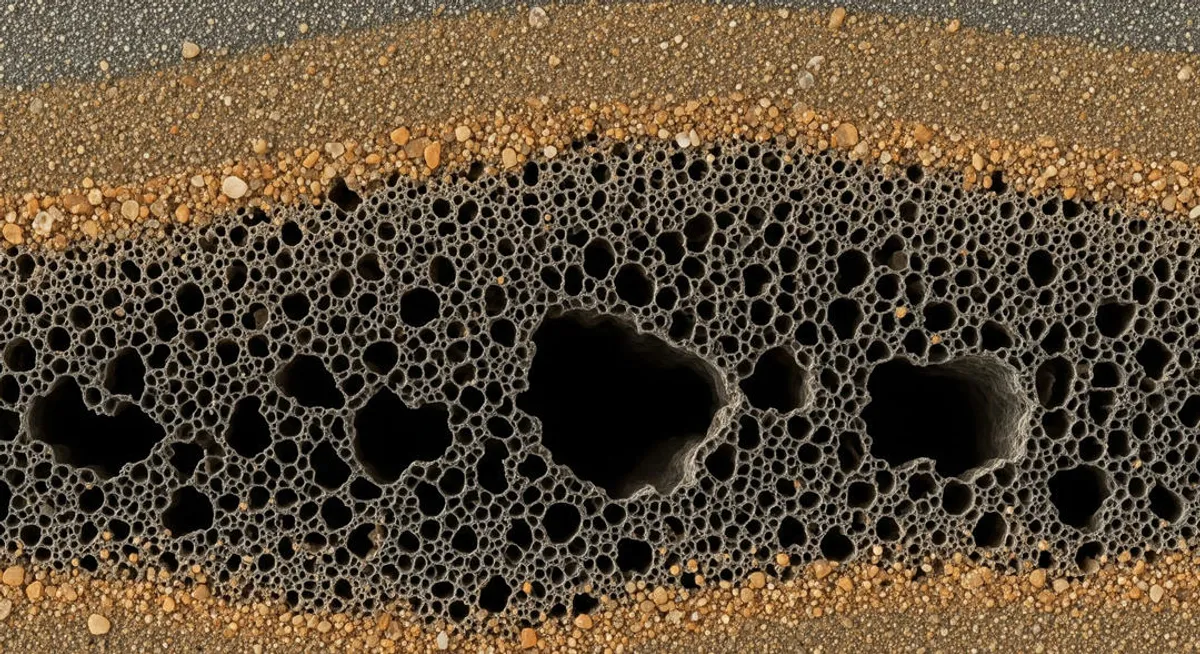
Porosity is the fraction of a rock’s volume that consists of pore spaces—tiny voids that can hold fluids like oil, gas, or water. Think of it as the “storage capacity” of a reservoir rock. In mathematical terms, porosity (denoted by ) is defined as:
where:
- is the volume of pore spaces.
- is the total volume of the rock (pores plus solid material).
Porosity is expressed as a fraction or percentage, typically ranging from 5% to 30% in petroleum reservoirs. But not all porosity is created equal-let’s explore the different types.
Types of Porosity
Porosity comes in various flavors, each with unique implications for reservoir performance:
- Total vs. Effective Porosity:
- Total Porosity: Includes all pore spaces, even those isolated or too small to contribute to fluid flow.
- Effective Porosity: Only counts interconnected pores that allow fluids to move, critical for reservoir productivity.
- Primary vs. Secondary Porosity:
- Primary Porosity: Formed during sediment deposition, like the spaces between sand grains in a sandstone.
- Secondary Porosity: Created after deposition through processes like mineral dissolution or fracturing, common in carbonates.
Info
Measuring Porosity: Laboratory Techniques
To quantify porosity, geologists turn to core samples—cylinders of rock extracted from wells. These samples are analyzed in the lab using precise techniques:
- Porosimetry by Helium: Helium gas is injected into a core sample. Because helium molecules are tiny, they penetrate even the smallest pores, allowing accurate measurement of total porosity.
- Mercury Injection: Mercury is forced into the rock under high pressure, generating capillary pressure curves that reveal pore size distribution and effective porosity.
- Micro-CT Scan: A high-tech imaging method that creates 3D models of the rock’s internal structure, showing pore networks in detail.
Each method has its strengths. For example, helium porosimetry is great for total porosity, while mercury injection helps understand how fluids move through pores.
Measuring Porosity: Geophysical Logging
In the field, we use well logs to estimate porosity without extracting cores. These tools measure physical properties of the rock from inside the wellbore:
- Density Log: Measures rock density. Lower density often indicates higher porosity, as pores reduce the rock’s mass.
- Neutron Log: Detects hydrogen atoms in fluids within pores, providing a direct estimate of porosity.
- Sonic Log: Measures the speed of sound waves through the rock. Slower wave speeds suggest higher porosity due to fluid-filled pores.
Tip
Porosity in Action: Case Study - Permian Basin
The Permian Basin in Texas, USA, is a textbook example of how porosity varies between rock types. Let’s compare two key formations:
| Rock Type | Porosity Type | Typical Porosity | Implications |
|---|---|---|---|
| Sandstones | Primary, effective | 15-25% | High-quality reservoirs due to interconnected pores. |
| Shales | Secondary, low effective | 5-10% | Poor reservoirs but excellent source rocks or seals. |
In the Permian’s sandstone reservoirs, primary porosity between quartz grains creates ideal storage for oil and gas. In contrast, shales like the Wolfcamp formation have lower porosity, often secondary due to microfractures, making them better as source rocks or seals than reservoirs.
Warning
Why Porosity Matters
Porosity directly impacts a reservoir’s storage capacity and, when combined with permeability, its flow capacity. High effective porosity in sandstones, like those in the Permian Basin, means more oil or gas can be stored and extracted. In carbonates, secondary porosity from fractures or dissolution can make or break a reservoir’s productivity.
Summary
Porosity is the foundation of reservoir characterization, defining how much hydrocarbon a rock can hold. By understanding total vs. effective and primary vs. secondary porosity, you can assess a reservoir’s potential. Laboratory techniques like helium porosimetry and mercury injection, paired with geophysical logs (density, neutron, sonic), provide precise measurements. Real-world cases like the Permian Basin show how porosity shapes exploration strategies. As you move forward, keep porosity in mind—it’s the first step to unlocking a reservoir’s secrets.
Cuestionario
-
What is the difference between total and effective porosity?
a) Total porosity includes only interconnected pores; effective includes all pores.
b) Total porosity includes all pores; effective includes only interconnected pores.
c) Total porosity is measured in the field; effective is measured in the lab.
Correct Answer: b) Total porosity includes all pores; effective includes only interconnected pores. -
Which technique is best for visualizing pore networks in 3D?
a) Helium porosimetry
b) Mercury injection
c) Micro-CT scan
Correct Answer: c) Micro-CT scan -
Why are sandstones in the Permian Basin considered high-quality reservoirs?
a) High secondary porosity from fractures
b) High effective porosity from interconnected pores
c) Low porosity but high permeability
Correct Answer: b) High effective porosity from interconnected pores
Bibliography
Sources Used
- AAPG Bulletin (2018). Advanced methods for porous media characterization. Available at https://www.aapg.org/publications/journals/bulletin.
- Selley, R. C., & Sonnenberg, S. A. (2014). Elements of Petroleum Geology (3rd ed.). Academic Press.
- Petroleum Engineering Handbook (L.W. Lake, SPE, 2017). Chapter on reservoir characterization.
Recommended Reading
- Hyne, N. J. (2012). Nontechnical Guide to Petroleum Geology, Exploration, Drilling & Production. PennWell Books. Available at https://www.pennwellbooks.com/nontechnical-guide-to-petroleum-geology-exploration-drilling-production/.
- Boggs, S. (2011). Principles of Sedimentology and Stratigraphy. Pearson.
Direct Links
- AAPG Educational Resources: Webinars and articles on reservoir characterization.
- SPE Technical Resources: Insights on porosity and petrophysical analysis.