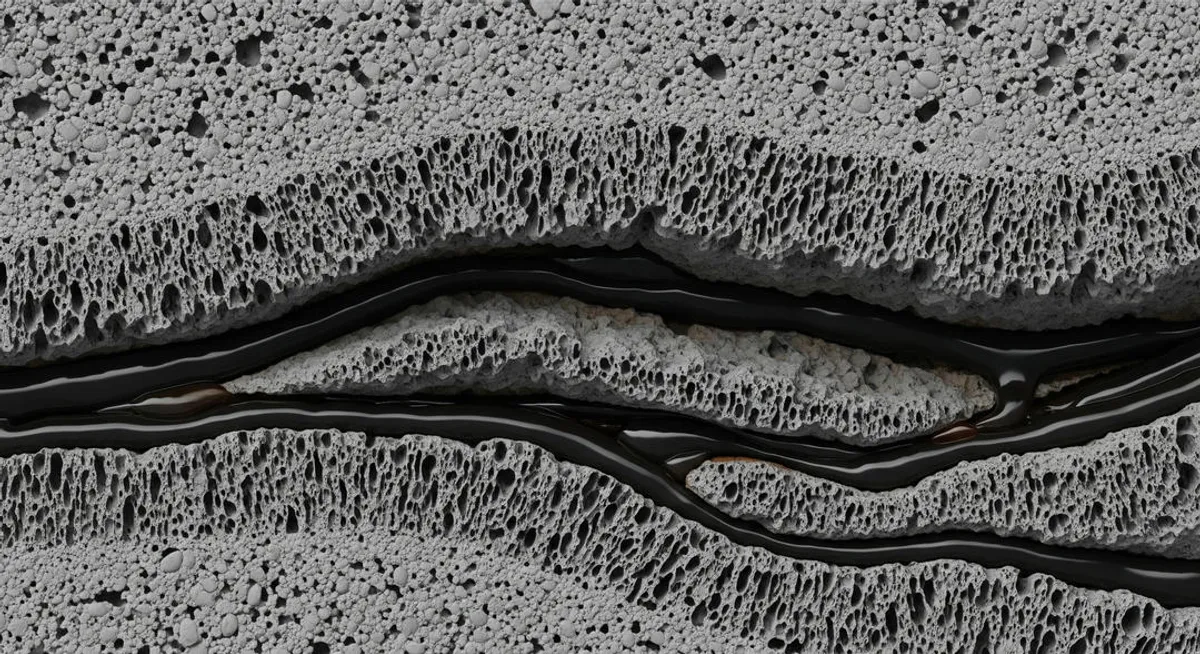
Permeability Darcy Law
- Published August 4, 2025
Introduction
Picture water flowing through a garden hose versus a sponge. The hose lets water rush through easily, while the sponge slows it down. In petroleum reservoirs, permeability is the property that controls how easily oil, gas, or water can flow through a rock’s pore spaces. Building on our understanding of porosity from Chapter 1, permeability is the next critical piece of the puzzle, determining whether a reservoir can produce hydrocarbons efficiently. This chapter explores Darcy’s Law, the cornerstone of fluid flow, the types of permeability, how we measure it, and how tools like Python’s FiPy library bring it to life.
What is Permeability?
Permeability measures a rock’s ability to allow fluids to pass through its interconnected pores. Think of it as the “flow highway” of a reservoir. High permeability means fluids move easily, like through a sandy beach, while low permeability is like trying to push water through clay—slow and difficult. Permeability is denoted by and is measured in darcys () or millidarcys (), with most reservoir rocks ranging from 1 to 1000 .
Info
Darcy’s Law: The Foundation of Fluid Flow
In 1856, Henry Darcy, a French engineer, discovered a simple yet powerful relationship governing fluid flow through porous media. Darcy’s Law describes how fluid flow rate depends on pressure differences, rock permeability, and fluid properties.
Darcy’s Law Equation
For linear flow (e.g., through a core sample in the lab):
Where:
- : Flow rate ()
- : Permeability ()
- : Cross-sectional area ()
- : Pressure difference across the sample ()
- : Fluid viscosity (centipoise, )
- : Length of the sample ()
For radial flow (e.g., around a well in a reservoir):
Where:
- : Reservoir thickness ()
- : Drainage radius ()
- : Well radius ()
Tip
Units: Darcy vs. Millidarcy
- A darcy is a large unit, defined so that a rock with 1 darcy permeability allows 1 of a 1 fluid to flow through a 1 area under a 1 pressure gradient.
- Most reservoirs have permeabilities in millidarcys (), where 1 = 1000 . For example, a sandstone might have 100 , while a shale might be 0.01 .
Types of Permeability
Not all permeability is the same. Let’s break it down:
- Absolute Permeability: The rock’s ability to conduct a single fluid (e.g., water) when fully saturated. It’s the baseline permeability of the rock.
- Effective Permeability: The ability to conduct one fluid (e.g., oil) in the presence of other fluids (e.g., water, gas). It depends on fluid saturation—the fraction of pores filled with each fluid.
- Relative Permeability: The ratio of effective permeability to absolute permeability, expressed as . It varies with saturation and is critical for multiphase flow.
| Type | Definition | Example |
|---|---|---|
| Absolute Permeability | Flow of a single fluid | Water through a core sample |
| Effective Permeability | Flow of one fluid with others present | Oil flow with water in pores |
| Relative Permeability | Effective permeability / absolute | for oil flow |
Warning
Measuring Permeability
Permeability is measured both in the lab and in the field, each method offering unique insights.
Core Analysis
Core samples from wells are tested in the lab using:
- Steady-State Method: A fluid (e.g., brine) is forced through a core at constant pressure, and the flow rate is measured to calculate using Darcy’s Law.
- Unsteady-State Method: Pressure is applied in pulses, and the transient response is analyzed to estimate permeability, useful for low-permeability rocks.
Transient Pressure Tests
In the field, well tests like drawdown or build-up tests measure pressure changes over time to estimate permeability. These tests analyze how pressure propagates through the reservoir, revealing and other properties like skin factor.
Computational Tools: Simulating Flow with Python
Modern reservoir engineers use computational tools to model fluid flow. The Python library FiPy solves partial differential equations for flow in porous media, simulating Darcy’s Law in complex geometries.
Here’s a simple example to calculate permeability using Darcy’s Law in Python:
# Calculate permeability (k) using Darcy’s Law for linear flow
Q = 10 # Flow rate (cm^3/s)
A = 20 # Cross-sectional area (cm^2)
delta_P = 5 # Pressure difference (atm)
mu = 2 # Viscosity (cP)
L = 100 # Length (cm)
k = (Q * mu * L) / (A * delta_P) # Permeability in darcys
print(f"Permeability: {k:.2f} darcys")This script computes for a core sample. For advanced simulations, FiPy can model 2D or 3D flow, incorporating permeability variations across a reservoir.
Practical Applications: Why Permeability Matters
Permeability determines a reservoir’s productivity. High-permeability sandstones, like those in the Brent field (North Sea), allow rapid oil flow, while low-permeability shales require fracturing to produce. Engineers use permeability data to:
- Design well completion strategies (e.g., hydraulic fracturing).
- Predict production rates.
- Optimize water or gas injection for enhanced recovery.
Info
Summary
Permeability is the gatekeeper of fluid flow in reservoirs, governed by Darcy’s Law, which links flow rate to pressure, permeability, and viscosity. Understanding absolute, effective, and relative permeability helps predict how oil, gas, and water move. Lab techniques like core analysis and field tests like transient pressure tests measure permeability, while tools like Python’s FiPy bring these concepts to life. Whether in the Brent field or your next reservoir model, permeability is key to unlocking production potential.
Cuestionario
-
What does Darcy’s Law describe?
a) The volume of pores in a rock
b) The flow of fluids through porous media
c) The compressibility of reservoir fluids
Correct Answer: b) The flow of fluids through porous media -
How does effective permeability differ from absolute permeability?
a) It accounts for multiple fluids in the pores
b) It measures only gas flow
c) It is always higher than absolute permeability
Correct Answer: a) It accounts for multiple fluids in the pores -
Which method is best for measuring permeability in low-permeability rocks?
a) Steady-state core analysis
b) Unsteady-state core analysis
c) Density logging
Correct Answer: b) Unsteady-state core analysis
Bibliography
Sources Used
- Petroleum Engineering Handbook (L.W. Lake, SPE, 2017). Chapter 5: Reservoir Characterization.
- Selley, R. C., & Sonnenberg, S. A. (2014). Elements of Petroleum Geology (3rd ed.). Academic Press.
- SPE Journal (2019). Advances in permeability measurement techniques.
Recommended Reading
- Hyne, N. J. (2012). Nontechnical Guide to Petroleum Geology, Exploration, Drilling & Production. PennWell Books. Available at https://www.pennwellbooks.com/nontechnical-guide-to-petroleum-geology-exploration-drilling-production/.
- Tiab, D., & Donaldson, E. C. (2015). Petrophysics: Theory and Practice of Measuring Reservoir Rock and Fluid Transport Properties. Gulf Professional Publishing.
Direct Links
- SPE Technical Resources: Insights on permeability and reservoir engineering.
- AAPG Educational Resources: Webinars on petrophysical analysis.