Fluid Saturation
- Published August 4, 2025
Introduction
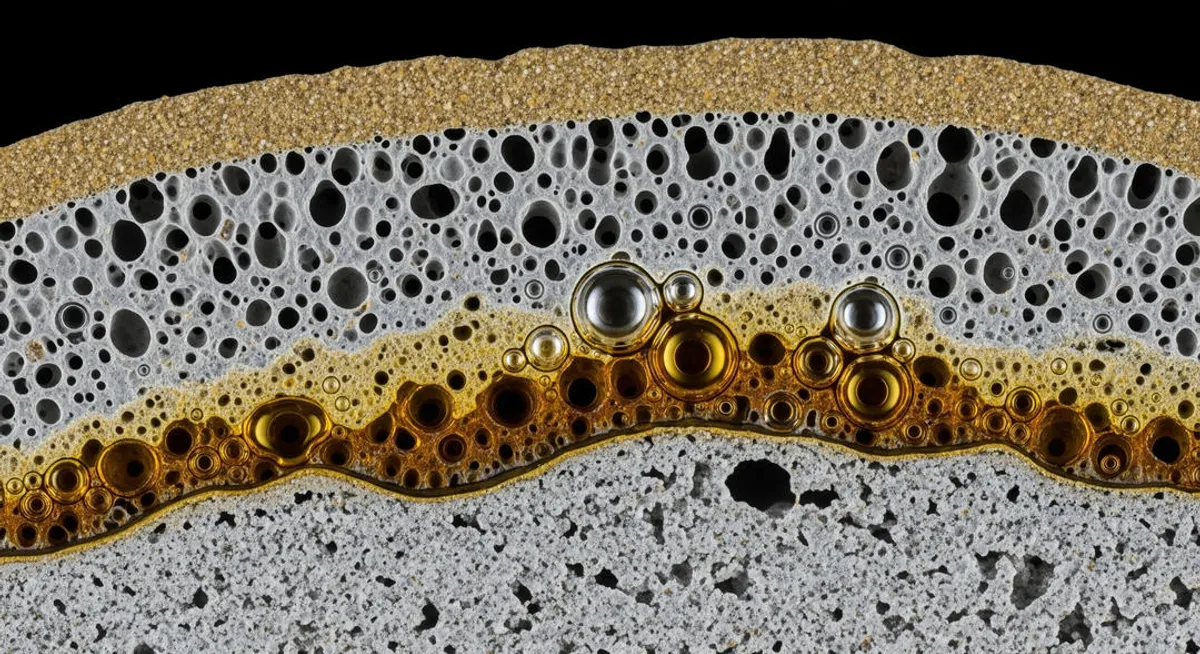
Imagine slicing open a sponge soaked with water, oil, and air. How much of each is trapped inside, and how tightly is it held? In petroleum reservoirs, fluid saturation tells us the proportion of pore space occupied by water, oil, or gas. This chapter builds on porosity (the storage capacity) and permeability (the flow capacity) to explore how fluids are distributed in a rock and why this matters for hydrocarbon production. We’ll dive into critical concepts like irreducible water or residual oil, learn how to measure saturation in the lab and field, and see it in action in a gas condensate reservoir. Let’s uncover how saturation shapes the life of a reservoir!
What is Fluid Saturation?
Fluid saturation is the fraction of a rock’s pore volume occupied by a specific fluid—water, oil, or gas. It’s expressed as a percentage or fraction and always sums to 1:
Where:
- : Water saturation
- : Oil saturation
- : Gas saturation
Saturation tells us not just how much fluid is present but also how it behaves in the reservoir. Some fluids are tightly bound to the rock, while others flow freely, impacting how much hydrocarbon we can extract.
Info
Key Definitions
Let’s meet the critical saturation terms that every reservoir engineer needs to know:
- Irreducible Water Saturation (): The minimum water content that remains trapped in the pores, held by capillary forces or adsorbed onto rock surfaces. It’s like water clinging to a sponge even after you squeeze it hard. Typical values range from 10% to 50% depending on the rock type.
- Residual Oil Saturation (): The oil left behind after water or gas displacement (e.g., during waterflooding). This oil is trapped in small pores or sticks to the rock, resisting flow. Values often range from 20% to 40%.
- Critical Gas Saturation (): The minimum gas saturation needed for gas to start flowing as a continuous phase. Below this threshold, gas bubbles are trapped and immobile, typically 5-10% in gas reservoirs.
| Term | Definition | Typical Range |
|---|---|---|
| Irreducible Water () | Water trapped by capillary forces | 10 % - 50 % |
| Residual Oil () | Oil left after displacement | 20 % - 40 % |
| Critical Gas () | Minimum gas for continuous flow | 5 % - 10 % |
Warning
Measuring Saturation: Laboratory Techniques
To know how much water, oil, or gas is in a rock, we start with core samples—small rock cylinders drilled from a well. These are analyzed in the lab using precise methods:
- Centrifugation: A core sample is spun at high speeds in a centrifuge, forcing fluids out of the pores. By measuring the volume of fluid displaced (e.g., oil or water), we calculate saturation. This method is great for determining and .
- Nuclear Magnetic Resonance (NMR) Spectroscopy: NMR detects hydrogen atoms in fluids within the pores. It distinguishes between movable fluids (e.g., oil that can flow) and bound fluids (e.g., irreducible water). NMR is non-destructive and provides detailed saturation profiles.
Tip
Measuring Saturation: Geophysical Logging
In the field, we use well logs to estimate saturation without pulling cores. The most powerful tool is the resistivity log, interpreted using Archie’s Equation, which relates electrical resistivity to water saturation.
Archie’s Equation
Developed by Gus Archie in the 1940s, this equation is a cornerstone of petrophysics:
Where:
- : Water saturation
- : Resistivity of formation water ()
- : True formation resistivity (from logs, )
- : Porosity (fraction)
- : Tortuosity factor (typically 0.6–1.0)
- : Cementation exponent (1.8–2.5, depending on rock type)
- : Saturation exponent (usually ~2)
How it works: Rocks with high water saturation conduct electricity well (low resistivity), while oil or gas (non-conductive) increases resistivity. By measuring and knowing , we solve for . Oil or gas saturation is then .
Info
Practical Example: Saturation in Gas Condensate Reservoirs
Gas condensate reservoirs, like the North Field in Qatar, are fascinating because they contain gas that can condense into liquid hydrocarbons as pressure drops. Let’s see how saturation plays out:
- Initial Conditions: The reservoir starts with high gas saturation () and low irreducible water (). Oil saturation () is negligible.
- Production Challenges: As pressure decreases, liquid hydrocarbons (condensate) form, increasing and reducing . If falls below , gas flow stops, trapping valuable hydrocarbons.
- Saturation Analysis: Using NMR, engineers measure to estimate producible gas. Resistivity logs with Archie’s Equation track changes in as water encroaches during production.
In the North Field, low (e.g., 20%) in high-porosity sandstones ensures ample space for gas, while monitoring saturation helps optimize production to avoid condensate buildup.
Why Saturation Matters
Saturation determines how much hydrocarbon is available and how easily it can be produced. High means less room for oil or gas, while high limits recovery. By combining lab measurements (centrifugation, ) with field data (Archie’s Equation), engineers estimate:
- Recoverable Reserves: Low and indicate more producible hydrocarbons.
- Production Strategies: Knowing helps manage gas reservoirs to prevent flow stoppage.
- Enhanced Recovery: Saturation data guides waterflooding or gas injection to displace residual oil.
Warning
Summary
Fluid saturation (, , ) defines how water, oil, and gas occupy a rock’s pores, with critical thresholds like irreducible water (), residual oil (), and critical gas () shaping production potential. Laboratory methods like centrifugation and , paired with geophysical logs using Archie’s Equation, provide accurate saturation estimates. In gas condensate reservoirs like the North Field, saturation data is vital for maximizing recovery. Understanding saturation unlocks the secrets of how fluids behave in a reservoir, setting the stage for deeper reservoir analysis.
Cuestionario
-
What does irreducible water saturation () represent?
a) Water that flows freely during production
b) Water trapped by capillary forces in the pores
c) Water injected during enhanced recovery
Correct Answer: b) Water trapped by capillary forces in the pores -
Which method is best for distinguishing movable from bound fluids in a core sample?
a) Centrifugation
b) Resistivity logging
c) NMR spectroscopy
Correct Answer: c) NMR spectroscopy -
In a gas condensate reservoir, what happens if gas saturation falls below ?
a) Gas flow increases
b) Gas becomes trapped and immobile
c) Oil saturation decreases
Correct Answer: b) Gas becomes trapped and immobile
Bibliography
Sources Used
- Journal of Petroleum Science and Engineering (2020). Applications of NMR in reservoir characterization. Available at https://www.journals.elsevier.com/journal-of-petroleum-science-and-engineering.
- Selley, R. C., & Sonnenberg, S. A. (2014). Elements of Petroleum Geology (3rd ed.). Academic Press.
- Petroleum Engineering Handbook (L.W. Lake, SPE, 2017). Chapter on petrophysical analysis.
Recommended Reading
- Tiab, D., & Donaldson, E. C. (2015). Petrophysics: Theory and Practice of Measuring Reservoir Rock and Fluid Transport Properties. Gulf Professional Publishing.
- Archie, G. E. (1942). The Electrical Resistivity Log as an Aid in Determining Some Reservoir Characteristics. SPE.
Direct Links
- SPE Technical Resources: Insights on saturation and petrophysical analysis.
- AAPG Educational Resources: Webinars on reservoir characterization and well logging.