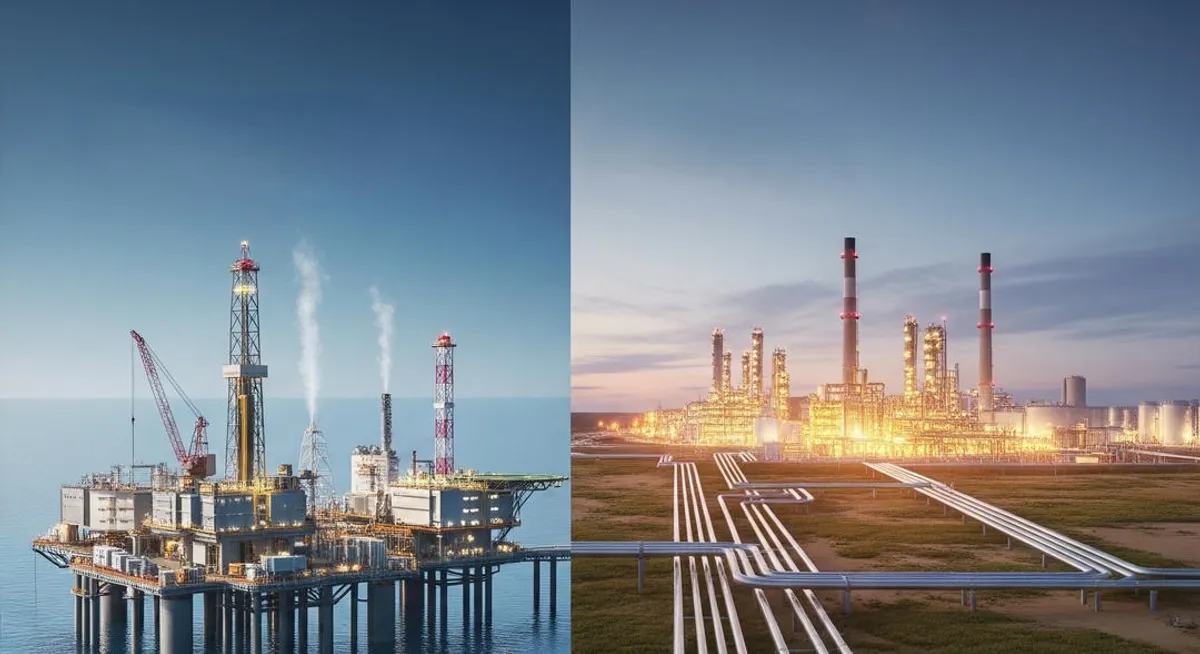
Introduction to Oil and Gas Field Development Phases
- Published August 4, 2025
Imagine an oil and gas field as a living project, evolving through distinct stages like the chapters of a book. Each stage—exploration, evaluation, development, production, and abandonment—has unique challenges and goals, and petroleum production engineers play a critical role in bringing the story to life. This chapter dives into the lifecycle of an oil and gas field, exploring how production engineering contributes to each phase. We’ll use real-world examples like the Ghawar field in Saudi Arabia and the Permian Basin in the USA, and sprinkle in some math to quantify key concepts, ensuring you grasp both the big picture and the technical details.
The Lifecycle of an Oil and Gas Field
The journey of an oil and gas field is a carefully orchestrated process, divided into five key phases. Each phase builds on the previous one, with production engineering becoming increasingly critical as the field matures. Let’s break down each phase and see how production engineers contribute.
Exploration: The Search Begins
Exploration is like a treasure hunt, where geoscientists use seismic surveys and geological data to find potential hydrocarbon deposits. Production engineers have a limited role here, but they start assessing whether a discovery can be produced economically.
- Key Activities : Mapping basins, identifying traps, drilling exploratory wells.
- Production Engineering Role : Provides input on production feasibility, such as estimating flow rates based on preliminary reservoir data.
- Example : In the Permian Basin, exploration teams used 3D seismic to identify shale formations, setting the stage for production planning.
Evaluation: Assessing the Prize
Once a discovery is made, the evaluation phase determines if it’s worth developing. This involves drilling appraisal wells and analyzing reservoir properties like porosity and permeability.
- Key Activities : Estimating reserves, assessing commercial viability.
- Production Engineering Role : Analyzes reservoir data to estimate production potential and plan surface facilities.
- Math Insight : Reserves are often estimated using the volumetric method:
where:
-
: Original oil in place (barrels)
-
: Reservoir area (acres)
-
: Reservoir thickness (feet)
-
: Porosity (fraction)
-
: Oil saturation (fraction)
-
: Water saturation (fraction)
-
: Oil formation volume factor ()
-
Example : In Ghawar, evaluation confirmed massive carbonate reservoirs, guiding production engineers to plan large-scale production systems.
Development: Building the Infrastructure
The development phase is where the field takes shape. Wells are drilled, and surface facilities like pipelines and separators are built. Production engineers are heavily involved, designing systems to extract hydrocarbons efficiently.
- Key Activities : Designing well completions, pipelines, and processing facilities.
- Production Engineering Role : Selects completion types (e.g., open-hole or cased-hole) and designs flowlines to handle expected production rates.
- Math Insight : Production engineers calculate required tubing size using flow rate equations, such as the Darcy-Weisbach equation for pressure drop:
where:
-
: Pressure drop ()
-
: Friction factor
-
: Pipe length ()
-
: Pipe diameter ()
-
: Fluid density ()
-
: Fluid velocity ()
-
Example : In the Permian Basin, production engineers designed horizontal wells with multi-stage fracturing to maximize recovery from tight shale.
Production: Harvesting the Resource
The production phase is the heart of the operation, where hydrocarbons are extracted and processed. This phase can last decades, and production engineers are at the forefront, optimizing well performance and addressing challenges like declining pressure or water production.
- Key Activities : Operating wells, managing artificial lift systems, monitoring production rates.
- Production Engineering Role : Optimizes well performance using techniques like gas lift or electrical submersible pumps (ESPs).
- Math Insight : Production rates are modeled using the Inflow Performance Relationship (IPR), such as Vogel’s equation for oil wells:
where:
-
: Oil flow rate ()
-
: Maximum flow rate ()
-
: Bottomhole flowing pressure ()
-
: Average reservoir pressure ()
-
Example : In Ghawar, production engineers used water injection to maintain reservoir pressure, sustaining high production rates for decades.
Abandonment: Closing the Chapter
When the field is no longer economically viable, it’s safely decommissioned. Production engineers ensure wells are plugged and facilities are dismantled responsibly.
- Key Activities : Plugging wells, restoring the site, ensuring environmental compliance.
- Production Engineering Role : Designs well abandonment procedures, such as cementing to seal the well.
- Example : In mature North Sea fields, production engineers use specialized cement formulations to ensure long-term well integrity.
Putting It Into Practice
Picture yourself as a production engineer in the Permian Basin. During the evaluation phase, you use reservoir data to estimate recoverable reserves. In development, you design horizontal wells with multi- stage fracturing. During production, you monitor flow rates and install ESPs to boost output. Finally, in abandonment, you ensure wells are sealed to prevent leaks. Each phase relies on your ability to integrate technical data and make informed decisions.
Summary
The lifecycle of an oil and gas field—exploration, evaluation, development, production, and abandonment— is a dynamic process where production engineering plays a pivotal role, especially in development and production. By understanding each phase and applying mathematical tools like reserve estimation and flow rate calculations, production engineers maximize recovery, optimize operations, and ensure sustain- ability. Fields like Ghawar and the Permian Basin show how these phases come together to create some of the world’s most productive operations.
Questionnaire
- What is the primary focus of the evaluation phase?
a) Drilling production wells to extract hydrocarbons.
b) Assessing the commercial viability of a discovery.
c) Decommissioning wells after depletion.
Answer : b) Assessing the commercial viability of a discovery. - Which equation is commonly used to model oil production rates in the production
phase?
a) Darcy-Weisbach equation.
b) Vogel’s equation.
c) Volumetric reserve equation.
Answer : b) Vogel’s equation. - In which phase do production engineers design well completions?
a) Exploration
b) Development
c) Abandonment
Answer : b) Development
Bibliography
Sources Used
-
SPE Paper 185629 (2017). Field Development Planning. Society of Petroleum Engineers. Details the lifecycle of oil and gas fields and production engineering roles.
-
Guo, B., Liu, X., & Tan, X. (2016). Petroleum Production Engineering: A Computer-Assisted Approach. Gulf Professional Publishing. Covers production engineering tasks across field phases.
-
Economides, M. J., Hill, A. D., Ehlig-Economides, C., & Zhu, D. (2013). Petroleum Production Systems (2nd ed.). Prentice Hall. Provides mathematical models for production engineering.
Recommended Reading
- Hyne, N. J. (2012). Nontechnical Guide to Petroleum Geology, Exploration, Drilling & Production. PennWell Books. Accessible overview of field lifecycle and production roles.
- Allen, T. O., & Roberts, A. P. (1989). Production Operations. Oil & Gas Consultants International. Practical insights into production and abandonment phases.
Direct Links
- SPE (Society of Petroleum Engineers)— Webinars and papers on field development.
- PennWell Books— Source for Hyne’s guide.
- AAPG Resources— Educational content on petroleum engineering.