Minerals Petroleum Geology Quartz Feldspars Clays
- Published August 3, 2025
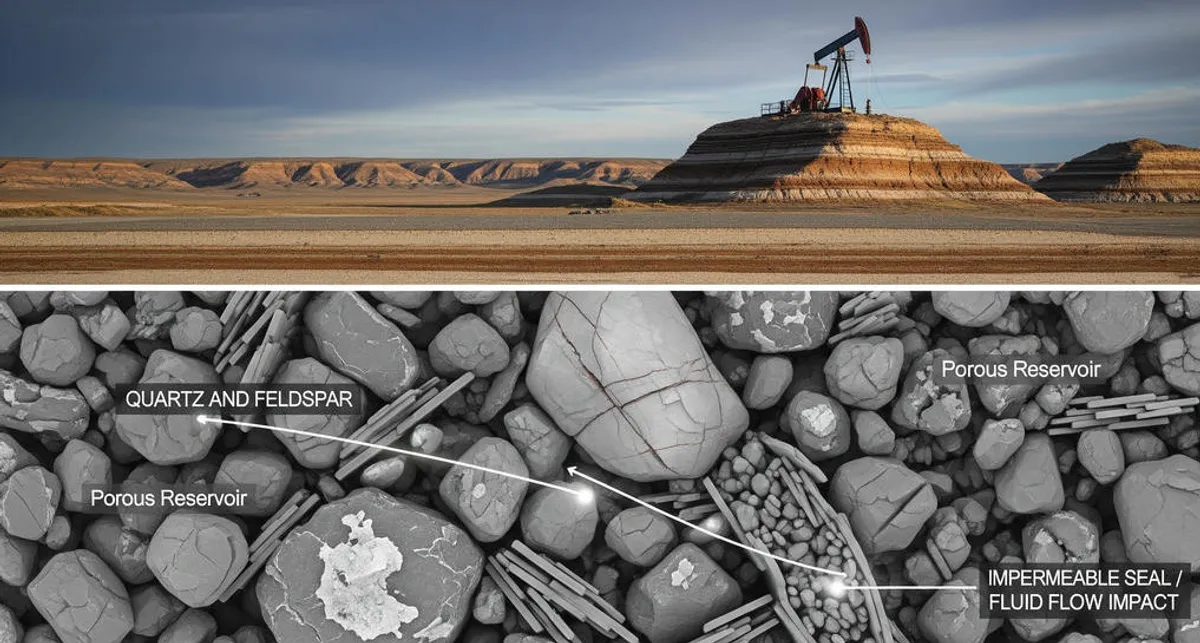
Minerals shape the rocks that form Earths crust and play a vital role in petroleum geology. Quartz feldspars and clays are essential components of sedimentary rocks influencing reservoir quality source rock potential and seal integrity. This exploration dives into their properties and how they impact hydrocarbon exploration using practical examples and modern analytical tools.
Quartz
Quartz a silicate mineral composed of silicon and oxygen is one of the most abundant minerals in Earths crust. Its durability and resistance to weathering make it a major component of clastic sedimentary rocks like sandstones. In petroleum systems quartz grains in sandstones create porous and permeable reservoirs ideal for storing oil and gas. The mineral’s stability ensures that these reservoirs maintain their structure under burial conditions. For example in the Brent field of the North Sea quartz-rich sandstones form high-quality reservoirs due to their robust grain framework.
Table 1 Quartz in Petroleum Systems
| Mineral | Composition | Petroleum Role | Example |
|---|---|---|---|
| Quartz | Silicon dioxide | Reservoir rock framework | Brent field (North Sea) |
- Significance High porosity and permeability in quartz-rich sandstones
- Exploration insight Geologists analyze quartz content to assess reservoir quality
Feldspars
Feldspars a group of silicate minerals including orthoclase and plagioclase are common in sedimentary rocks but less durable than quartz. They weather into clays under surface conditions affecting reservoir quality. In sandstones feldspars can dissolve during burial creating secondary porosity that enhances reservoir capacity. However their breakdown into clays can reduce permeability if not managed. In the Permian Basin (USA) feldspar-rich sandstones contribute to reservoir porosity through dissolution while their clay byproducts impact drilling strategies.
- Significance Contribute to secondary porosity or clay formation
- Case study Feldspar dissolution in the Permian Basin enhances sandstone reservoir quality
Clays
Clays tiny silicate minerals like kaolinite illite and smectite form through the weathering of other minerals like feldspars. Their fine grain size and reactivity make them critical in petroleum systems. In shales clays trap organic matter forming source rocks that generate hydrocarbons. They also act as seals due to their low permeability preventing hydrocarbon leakage. However clay swelling in reservoirs can reduce permeability complicating drilling. The Vaca Muerta formation in Argentina relies on clay-rich shales as source rocks while their sealing capacity traps hydrocarbons.
Table 2 Feldspars and Clays in Petroleum Systems
| Mineral | Formation | Petroleum Role | Example |
|---|---|---|---|
| Feldspars | Silicate minerals | Secondary porosity clays | Permian Basin (USA) |
| Clays | Weathering byproducts | Source rocks seals | Vaca Muerta (Argentina) |
Mineral Interactions in the Rock Cycle
Quartz feldspars and clays interact within the rock cycle to form sedimentary rocks critical for petroleum systems. Quartz provides the durable framework for reservoirs while feldspars weather into clays that contribute to source rocks or seals. Clays also influence reservoir quality by filling pore spaces or swelling during drilling. In the Gulf of Mexico quartz-rich sandstones form reservoirs while clay-rich shales act as source rocks and seals creating a complete petroleum system shaped by sediment deposition and tectonic activity.
Exploration Applications
Geologists study these minerals to evaluate hydrocarbon potential. Petrographic analysis identifies quartz and feldspar content to assess reservoir porosity. Geochemical studies measure clay composition and organic content in shales to predict source rock quality. Core samples and well logs help map mineral distribution in basins. For example in the Permian Basin geologists use thin-section analysis to quantify quartz and feldspar in sandstones ensuring high-quality reservoirs.
- Analytical tools
- Petrography for mineral identification
- Geochemistry for source rock evaluation
- Well logging for mineral distribution
Future Trends
Advanced technologies enhance mineral analysis in exploration. X-ray diffraction (XRD) precisely identifies clay types and their impact on reservoir performance. Scanning electron microscopy (SEM) reveals pore structures in quartz and feldspar-rich rocks. Machine learning integrates mineral data with seismic and well logs to predict reservoir quality. These tools are critical in unconventional plays like Vaca Muerta where clay-rich shales require detailed analysis for successful extraction.
Summary
Quartz feldspars and clays shape petroleum systems by forming reservoirs source rocks and seals. Quartz provides durable reservoir frameworks feldspars enhance porosity through dissolution and clays act as source rocks and seals. Advanced tools like XRD SEM and machine learning help geologists target hydrocarbon-rich basins with precision.
Cuestionario
-
Which mineral is most critical for forming reservoir frameworks?
a) Feldspars
b) Quartz
c) Clays
Correct Answer b) Quartz -
What role do clays primarily play in petroleum systems?
a) Reservoir frameworks
b) Source rocks and seals
c) Secondary porosity
Correct Answer b) Source rocks and seals -
How do feldspars contribute to reservoir quality?
a) Form seals
b) Create secondary porosity
c) Trap organic matter
Correct Answer b) Create secondary porosity
Bibliography
Sources Used
- Selley R C & Sonnenberg S A (2014) Elements of Petroleum Geology (3rd ed) Academic Press
Explains mineral roles in petroleum systems - USGS (2020) Geologic Framework of Sedimentary Basins Available at https://www.usgs.gov/energy-and-minerals/energy-resources-program
Details mineral composition in sedimentary rocks - AAPG Memoir 60 (1994) The Petroleum System From Source to Trap American Association of Petroleum Geologists
Connects minerals to hydrocarbon formation
Recommended Reading
- Hyne N J (2012) Nontechnical Guide to Petroleum Geology Exploration Drilling & Production PennWell Books
Accessible overview of minerals and petroleum geology Available at https://www.pennwellbooks.com/nontechnical-guide-to-petroleum-geology-exploration-drilling-production/ - Boggs S (2011) Principles of Sedimentology and Stratigraphy Pearson
In-depth analysis of mineral formation in sedimentary rocks
Direct Links
- AAPG Educational Resources Webinars and articles on minerals and petroleum geology
- USGS Energy Resources Program Information on mineral roles in basins
- SPE Technical Resources Insights on mineral analysis in oil and gas exploration