Mineralogy Impact Drilling Petrophysical Properties
- Published August 3, 2025
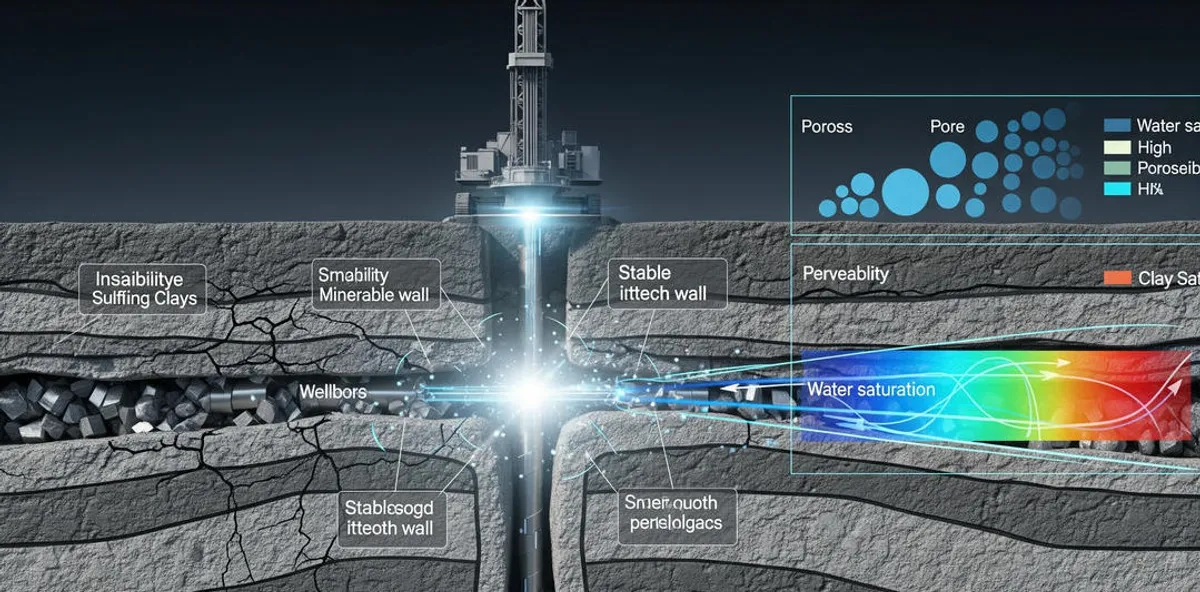
Mineralogy governs the behavior of rocks during drilling and their petrophysical properties like porosity and permeability which are critical for hydrocarbon exploration. Minerals such as quartz clays and carbonates affect well stability drilling efficiency and reservoir performance. This exploration examines how these minerals shape drilling operations and the evaluation of oil and gas reservoirs using real-world examples and advanced analytical tools.
Quartz in Drilling and Petrophysics
Quartz a durable silicate mineral forms the backbone of many sandstone reservoirs. Its hardness enhances reservoir stability but poses challenges during drilling as it wears down drill bits. Quartz-rich sandstones typically exhibit high porosity and permeability making them excellent reservoirs for hydrocarbons. In the North Sea Brent field quartz-dominated sandstones provide robust reservoirs with high flow rates due to their stable grain framework. Petrophysical analysis focuses on quartz content to predict reservoir quality ensuring efficient hydrocarbon extraction.
Table 1 Quartz Impact on Drilling and Petrophysics
| Mineral | Drilling Impact | Petrophysical Role | Example |
|---|---|---|---|
| Quartz | Wears drill bits | High porosity permeability | Brent field (North Sea) |
Clays and Drilling Challenges
Clays like kaolinite illite and smectite are fine-grained minerals common in shales and sandstones. Their reactivity with drilling fluids can cause swelling or dispersion leading to wellbore instability. Smectite for example swells when exposed to water-based fluids risking stuck pipes or hole collapse. In petrophysics clays reduce permeability by clogging pore spaces but are critical in shales as source rocks or seals. The Vaca Muerta formation in Argentina contains clay-rich shales that generate hydrocarbons but require careful drilling to manage swelling.
- Drilling considerations
- Use oil-based fluids to minimize clay swelling
- Monitor clay content to prevent wellbore collapse
- Petrophysical significance Clays act as source rocks or seals but reduce reservoir permeability
Carbonates and Petrophysical Properties
Carbonate minerals like calcite and dolomite form limestone and dolomite reservoirs. Their solubility creates complex pore networks enhancing porosity but varying permeability. Carbonates are prone to dissolution during drilling which can lead to lost circulation where drilling fluid escapes into the formation. In the Ghawar field in Saudi Arabia carbonate reservoirs offer high porosity but require precise petrophysical analysis to map permeability variations for optimal production.
- Drilling considerations Manage fluid loss in soluble carbonates
- Petrophysical significance High porosity variable permeability in carbonate reservoirs
- Case study Ghawar field carbonates rely on fracture networks for hydrocarbon flow
Mineralogy in Reservoir Evaluation
Mineralogy directly influences petrophysical properties critical for reservoir evaluation. Quartz ensures stable high-porosity reservoirs while clays impact permeability and seal integrity. Carbonates create complex reservoirs with variable flow paths. Geologists use well logs like gamma ray and resistivity to identify mineral content and assess porosity and permeability. In the Permian Basin geologists combine log data with core samples to evaluate quartz and clay distribution ensuring accurate reservoir characterization.
Table 2 Mineral Impacts on Petrophysical Properties
| Mineral | Petrophysical Impact | Exploration Application |
|---|---|---|
| Quartz | High porosity permeability | Predicts reservoir quality |
| Clays | Reduced permeability seals | Evaluates source rock seal potential |
| Carbonates | Complex porosity variable permeability | Maps reservoir flow paths |
Analytical Tools
Advanced tools help geologists analyze mineralogy for drilling and petrophysics. X-ray diffraction (XRD) identifies clay types and their swelling potential guiding drilling fluid selection. Scanning electron microscopy (SEM) reveals pore structures in quartz and carbonate rocks. Machine learning integrates well logs and core data to predict mineral distribution and reservoir performance. These tools are vital in complex basins like Vaca Muerta where clay and carbonate interactions complicate drilling and production.
Future Trends
Emerging technologies enhance mineralogical analysis in exploration. Automated XRD systems provide rapid clay identification improving drilling efficiency. Nuclear magnetic resonance (NMR) logging measures porosity and permeability in carbonate reservoirs. Machine learning models predict mineral-related drilling risks like clay swelling or bit wear. These advancements are transforming exploration in unconventional plays like the Permian Basin where precise mineral data drives success.
Summary
Mineralogy shapes drilling operations and petrophysical properties in petroleum geology. Quartz supports stable reservoirs but wears drill bits clays pose swelling risks but form source rocks and seals and carbonates create complex reservoirs with variable permeability. Advanced tools like XRD SEM and machine learning enable geologists to optimize drilling and evaluate hydrocarbon potential with precision.
Cuestionario
-
Which mineral enhances reservoir porosity but challenges drilling due to hardness?
a) Clays
b) Quartz
c) Carbonates
Correct Answer b) Quartz -
What is a key drilling challenge associated with clays?
a) High porosity
b) Swelling and wellbore instability
c) Fluid loss
Correct Answer b) Swelling and wellbore instability -
How do carbonates impact petrophysical properties?
a) Form seals and source rocks
b) Create complex porosity and variable permeability
c) Enhance drill bit wear
Correct Answer b) Create complex porosity and variable permeability
Bibliography
Sources Used
- Selley R C & Sonnenberg S A (2014) Elements of Petroleum Geology (3rd ed) Academic Press
Explains mineral impacts on drilling and petrophysics - USGS (2020) Geologic Framework of Sedimentary Basins Available at https://www.usgs.gov/energy-and-minerals/energy-resources-program
Details mineral roles in reservoir evaluation - AAPG Memoir 60 (1994) The Petroleum System From Source to Trap American Association of Petroleum Geologists
Connects mineralogy to hydrocarbon systems
Recommended Reading
- Hyne N J (2012) Nontechnical Guide to Petroleum Geology Exploration Drilling & Production PennWell Books
Accessible overview of mineralogy in petroleum geology Available at https://www.pennwellbooks.com/nontechnical-guide-to-petroleum-geology-exploration-drilling-production/ - Boggs S (2011) Principles of Sedimentology and Stratigraphy Pearson
In-depth analysis of mineral impacts on sedimentary rocks
Direct Links
- AAPG Educational Resources Webinars and articles on mineralogy and petroleum geology
- USGS Energy Resources Program Information on mineral roles in basins
- SPE Technical Resources Insights on mineral analysis in drilling and exploration