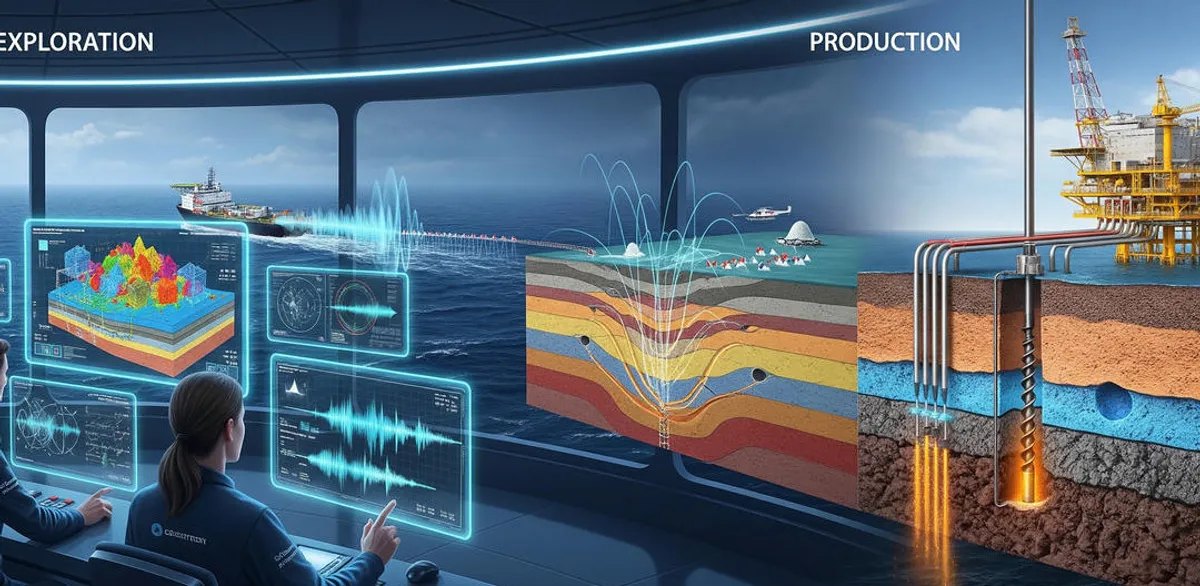
Geology in the Oil and Gas Industry: Exploration vs. Production
- Published August 3, 2025
Geology is the cornerstone of the oil and gas industry, guiding everything from the search for new reservoirs to the optimization of their extraction. This chapter explores the role of geoscientists in the exploration (finding hydrocarbons) and production (extracting them efficiently) phases, emphasizing how their decisions impact safety, costs, and sustainability. Through practical examples, we connect geological fundamentals with interdisciplinary collaboration and modern industry trends.
Geology in the Value Chain
The oil and gas industry operates within a value chain that includes exploration, appraisal, development, production, and abandonment. Geoscientists contribute knowledge about the Earth’s structure and composition to:
- Identify and evaluate reservoirs (exploration).
- Characterize and optimize reservoirs (production).
- Ensure safe and sustainable operations (all phases).
Key Contributions of Geoscientists
- Data analysis: Interpret seismic data, well logs, and core samples to map subsurface structures.
- Risk assessment: Estimate the Probability of Success (POS) in exploration and mitigate geological risks in production.
- Interdisciplinary collaboration: Work with engineers and data scientists to design wells and extraction strategies.
Table 1: Role of Geology in the Value Chain
| Stage | Geoscientist Tasks | Impact |
|---|---|---|
| Exploration | Map basins, identify traps, evaluate petroleum systems | Defines drilling locations, reduces geological risks |
| Production | Model reservoirs, optimize well trajectories | Enhances extraction efficiency |
| Abandonment | Assess seals for safe well closure | Ensures environmental compliance |
Exploration: The Search for Hydrocarbons
Exploration focuses on finding and evaluating viable reservoirs. Geoscientists:
-
Analyze Sedimentary Basins:
- Identify geological depressions with potential for source rock, reservoir, seal, and trap.
- Example: The Gulf of Mexico Basin, rich in stratigraphic and structural traps.
-
Use Geophysical Tools:
- 2D/3D Seismic: Maps subsurface structures like anticlines or faults.
- Well logs: Identify lithologies and fluids (water, oil, gas).
- Core analysis: Confirms the presence of reservoir rocks.
-
Assess Geological Risks:
- Calculate the Probability of Success (POS) based on factors like source rock maturity and seal integrity.
- Example: A prospect with good source rock but no effective trap has high uncertainty.
Case Study: In Vaca Muerta, Argentina, geoscientists used 3D seismic to identify combined traps (structural and stratigraphic), guiding successful exploratory well drilling.
Production: Optimizing Extraction
In production, geoscientists characterize the reservoir to maximize hydrocarbon recovery:
-
Reservoir Characterization:
- Determine porosity, permeability, and fluid saturation through petrophysics.
- Create 3D geological models to simulate hydrocarbon flow.
-
Well Design:
- Plan trajectories to target high-productivity zones.
- Example: In carbonate reservoirs, geoscientists identify natural fractures to guide horizontal wells.
-
Continuous Monitoring:
- Use 4D seismic to track reservoir changes (e.g., water front movement).
- Adjust strategies based on updated data.
Case Study: In the Ghawar field (Saudi Arabia), geoscientists used 3D models to optimize water injection, increasing recovery by 10%.
Exploration vs. Production: Key Differences
While both phases rely on geology, their approaches differ:
Table 2: Comparison of Exploration and Production
| Aspect | Exploration | Production |
|---|---|---|
| Objective | Find and evaluate reservoirs | Extract hydrocarbons efficiently |
| Scale | Regional (basins) | Local (specific reservoir) |
| Risk | High (geological uncertainty) | Low (confirmed reservoir) |
| Tools | Seismic, well logs, core analysis | 3D models, 4D seismic, petrophysics |
Multidisciplinary Integration
Geoscientists collaborate with:
- Drilling engineers: To design wells that avoid unstable formations (e.g., reactive shales).
- Reservoir engineers: To model fluid flow and optimize production.
- Data scientists: To analyze large volumes of seismic and well data using artificial intelligence.
Example: In an offshore project, a geoscientist interprets an anticline in seismic data, the drilling engineer designs the well trajectory, and a data scientist uses machine learning to predict high-porosity zones.
Relevance in the Current Context
Geology is key not only for hydrocarbons but also for:
- Unconventional reservoirs: Characterizing shale plays for hydraulic fracturing.
- Energy transition: Applying knowledge to CO₂ storage and geothermal energy.
- Sustainability: Ensuring effective seals during well abandonment.
Summary
Geology guides exploration (finding reservoirs) and production (extracting hydrocarbons) through data analysis, risk assessment, and interdisciplinary collaboration. Geoscientists are essential for reducing costs, enhancing safety, and supporting the energy transition.
Questionnaire
-
What is the primary objective of geoscientists in the exploration phase?
a) Optimize hydrocarbon extraction.
b) Identify and evaluate potential reservoirs.
c) Monitor reservoir changes during production.
Correct Answer: b) Identify and evaluate potential reservoirs. -
Which tool is most commonly used in the production phase to characterize reservoirs?
a) 2D seismic.
b) 3D geological models.
c) Core analysis exclusively.
Correct Answer: b) 3D geological models. -
Why is multidisciplinary integration important in the oil industry?
a) To reduce the need for geological data.
b) To combine expertise from geologists, engineers, and data scientists.
c) To eliminate exploration and focus solely on production.
Correct Answer: b) To combine expertise from geologists, engineers, and data scientists.
Bibliography
Sources Used
- Selley, R. C., & Sonnenberg, S. A. (2014). Elements of Petroleum Geology (3rd ed.). Academic Press.
Provides an overview of the role of geology in exploration and production. - AAPG Memoir 60: The Petroleum System—From Source to Trap (1994). American Association of Petroleum Geologists.
Details the importance of petroleum systems in exploration. - USGS Professional Papers: Geology and Assessment of Conventional Oil and Gas Resources. Available at: https://www.usgs.gov/energy-and-minerals/energy-resources-program.
Recommended Reading
- Hyne, N. J. (2012). Nontechnical Guide to Petroleum Geology, Exploration, Drilling & Production. PennWell Books.
Accessible introduction to petroleum geology. Available at: https://www.pennwellbooks.com/nontechnical-guide-to-petroleum-geology-exploration-drilling-production/. - Bjorlykke, K. (2010). Petroleum Geoscience: From Sedimentary Environments to Rock Physics. Springer.
Explores the integration of geology and production.
Direct Links
- AAPG Educational Resources – Webinars and articles on petroleum geology.
- SPE (Society of Petroleum Engineers) – Resources on exploration and production.
- USGS Energy Resources Program – Information on basins and petroleum systems.