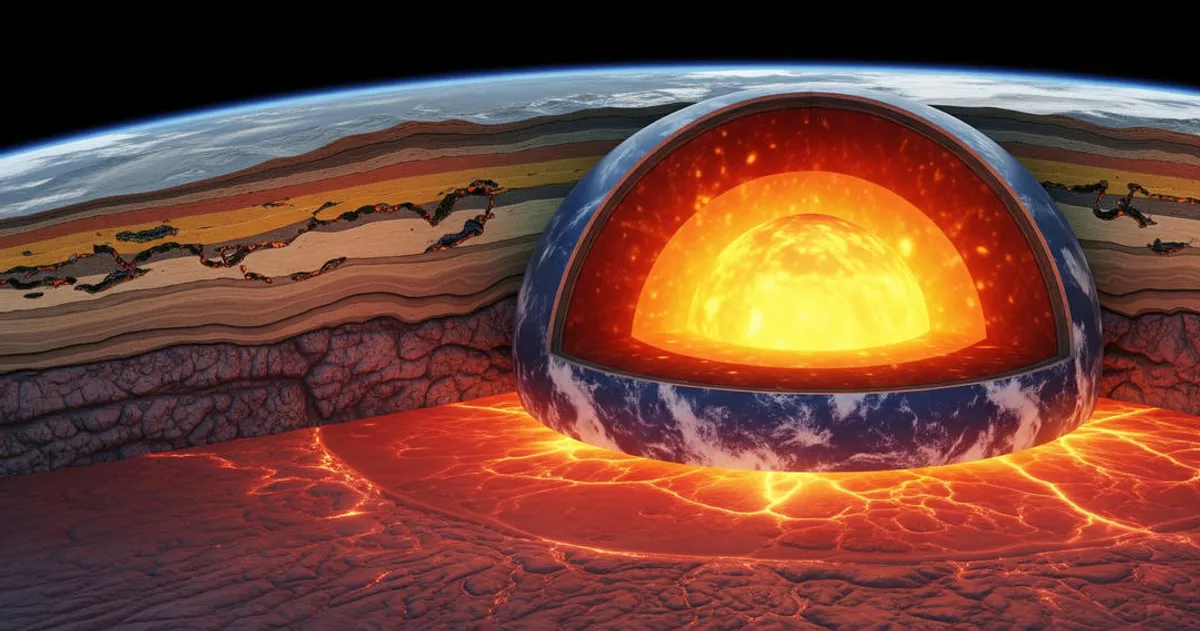
Earth Composition Crust Mantle Core
- Published August 3, 2025
Understanding Earths internal structure is fundamental to petroleum geology. The crust mantle and core shape the geological processes that form sedimentary basins where hydrocarbons accumulate. This exploration details the properties of these layers their interactions and their role in creating environments for oil and gas exploration.
Composition of Earths Layers
Earth consists of three primary layers crust mantle and core each with distinct physical and chemical properties that influence geological processes.
Crust
- Description The outermost layer thin and rigid varying in thickness from 5-10 km beneath oceans to 30-70 km under continents
- Types
- Oceanic crust Composed mainly of basalt denser (about 3.0 g/cm³) and thinner
- Continental crust Composed of granite less dense (about 2.7 g/cm³) and thicker
- Relevance to petroleum geology The crust hosts sedimentary basins where hydrocarbons form and accumulate. Continental crust often contains thick sedimentary sequences ideal for oil and gas reservoirs
- Example The thick continental crust in the Permian Basin (USA) supports extensive sedimentary layers rich in hydrocarbons
Mantle
- Description A thick layer (about 2900 km) beneath the crust composed of silicate rocks rich in magnesium and iron
- Properties Semi-solid with plastic behavior allowing convection currents that drive plate tectonics
- Relevance to petroleum geology Mantle convection influences tectonic processes like rifting and subduction which form sedimentary basins
- Example Mantle-driven rifting in the North Sea created basins that host major oil fields like Brent
Core
- Description The innermost layer divided into a liquid outer core (2200 km thick) and a solid inner core primarily iron and nickel
- Properties Generates Earths magnetic field and contributes to heat flow that drives mantle convection
- Relevance to petroleum geology Indirectly influences basin formation through heat flow affecting the thermal maturation of source rocks
- Example Heat from the core contributes to the thermal gradient in the Gulf of Mexico maturing organic-rich source rocks
Table 1 Properties of Earths Layers
| Layer | Composition | Thickness | Density (g/cm³) | Role in Petroleum Geology |
|---|---|---|---|---|
| Crust | Basalt (oceanic) Granite (continental) | 5-70 km | 2.7-3.0 | Hosts sedimentary basins and reservoirs |
| Mantle | Silicate rocks (Mg Fe) | ~2900 km | 3.3-5.6 | Drives tectonics forming basins |
| Core | Iron nickel | ~3500 km | 9.9-13.0 | Influences heat flow for source rock maturation |
Interactions Between Layers
The layers interact through dynamic processes that shape Earths surface and subsurface.
- Crust-Mantle Interaction The crust floats on the semi-fluid mantle with tectonic processes like rifting and subduction driven by mantle convection. These processes create basins where sediments accumulate
- Mantle-Core Interaction Heat from the core drives convection in the mantle influencing tectonic activity and basin formation
- Example In the East African Rift mantle upwelling thins the crust creating rift basins with potential for hydrocarbon exploration
Role in Sedimentary Basin Formation
Sedimentary basins are critical for hydrocarbon accumulation and their formation is tied to Earths internal structure.
- Rift Basins Formed by crustal thinning due to mantle upwelling. Example East African Rift
- Foreland Basins Created by crustal loading during mountain building influenced by mantle dynamics. Example Andean foreland basins
- Passive Margin Basins Developed along continental margins after rifting. Example Gulf of Mexico
- Thermal Maturation Heat flow from the core and mantle drives the maturation of organic matter in source rocks turning it into oil or gas
Case Study
In the Gulf of Mexico geologists identified a passive margin basin with thick sedimentary layers. The crusts thin oceanic portion and mantle-driven subsidence created ideal conditions for deepwater reservoirs. Core heat flow matured source rocks generating significant oil reserves.
Implications for Petroleum Exploration
Understanding Earths layers guides exploration strategies.
- Basin Identification Geologists use seismic data to map crustal thickness and basin geometry identifying potential hydrocarbon traps
- Thermal History Analysis of heat flow from the core and mantle helps predict source rock maturation
- Tectonic Context Recognizing mantle-driven processes like rifting or subduction informs basin type and exploration risks
- Example In the North Sea geologists targeted rift basins using seismic imaging to locate reservoirs formed by crustal extension
Table 2 Basin Types and Formation Processes
| Basin Type | Formation Process | Example | Hydrocarbon Potential |
|---|---|---|---|
| Rift Basin | Crustal thinning mantle upwelling | East African Rift | High (thick sediments) |
| Foreland Basin | Crustal loading mountain building | Andean Basins | Moderate to high |
| Passive Margin | Post-rift subsidence | Gulf of Mexico | High (deepwater reservoirs) |
Future Trends
Advancements in technology enhance the study of Earths layers for petroleum geology.
- Seismic Imaging High-resolution 3D seismic maps crustal and mantle structures with greater precision
- Geothermal Modeling Improved models of core and mantle heat flow refine predictions of source rock maturation
- Machine Learning Algorithms analyze seismic and well data to identify basin-forming processes
Summary
Earths crust mantle and core shape the geological processes that form sedimentary basins critical for hydrocarbon exploration. The crust hosts reservoirs the mantle drives tectonic processes and the core influences thermal maturation. Understanding these layers and their interactions enables geologists to identify prospective basins and optimize exploration strategies.
Cuestionario
-
What is the primary role of the crust in petroleum geology?
a) Drives tectonic processes
b) Hosts sedimentary basins and reservoirs
c) Generates Earths magnetic field
Correct Answer b) Hosts sedimentary basins and reservoirs -
How does the mantle contribute to basin formation?
a) Provides heat for source rock maturation
b) Drives convection leading to rifting and subduction
c) Directly forms hydrocarbon reservoirs
Correct Answer b) Drives convection leading to rifting and subduction -
Which basin type is associated with post-rift subsidence?
a) Rift Basin
b) Foreland Basin
c) Passive Margin Basin
Correct Answer c) Passive Margin Basin
Bibliography
Sources Used
- Selley R C & Sonnenberg S A (2014) Elements of Petroleum Geology (3rd ed) Academic Press
Describes Earths structure and its role in basin formation - USGS (2020) Geologic Framework of Sedimentary Basins Available at https://www.usgs.gov/energy-and-minerals/energy-resources-program
Details basin types and their geological context - AAPG Memoir 60 (1994) The Petroleum System From Source to Trap American Association of Petroleum Geologists
Connects Earths layers to hydrocarbon systems
Recommended Reading
- Hyne N J (2012) Nontechnical Guide to Petroleum Geology Exploration Drilling & Production PennWell Books
Accessible introduction to Earths structure and petroleum geology Available at https://www.pennwellbooks.com/nontechnical-guide-to-petroleum-geology-exploration-drilling-production/ - Bjorlykke K (2010) Petroleum Geoscience From Sedimentary Environments to Rock Physics Springer
In-depth analysis of geological processes in basin formation
Direct Links
- AAPG Educational Resources Webinars and articles on Earths structure and petroleum geology
- USGS Energy Resources Program Information on sedimentary basins
- SPE Technical Resources Insights on geological applications in oil and gas