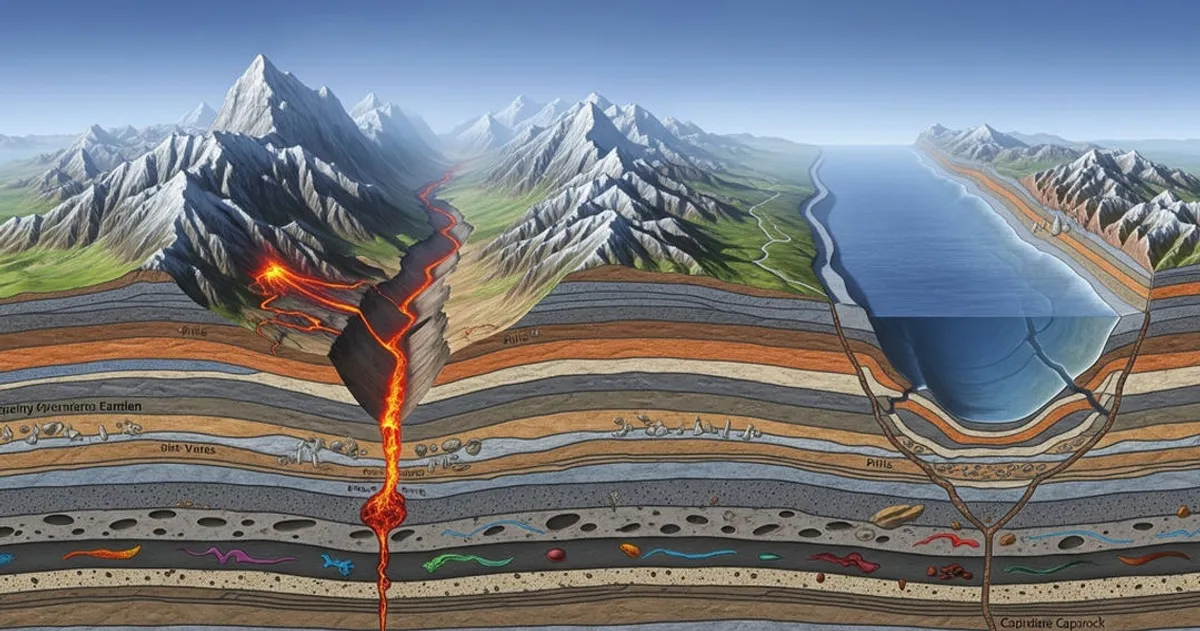
Continental Drift Plate Tectonics Scientific Evidence
- Published August 3, 2025
The movement of continents and the dynamics of Earths lithospheric plates form the foundation of modern geology. Continental drift and plate tectonics explain how Earths surface evolves creating sedimentary basins essential for hydrocarbon accumulation. This exploration details the scientific evidence behind these theories and their significance in petroleum geology.
Continental Drift
Proposed by Alfred Wegener in 1912 continental drift suggests continents were once joined and have since moved apart. This theory laid the groundwork for understanding Earths dynamic surface.
- Concept Continents float on a semi-fluid mantle moving over geological time
- Significance for petroleum geology Continental movement forms basins where sediments and hydrocarbons accumulate
- Example The breakup of Pangaea created rift basins like those in the North Sea rich in oil reserves
Scientific Evidence for Continental Drift
Multiple lines of evidence support Wegeners theory validated over decades through geological and geophysical studies.
Fit of Continents
- Observation The coastlines of continents like South America and Africa fit together like puzzle pieces
- Evidence Precise matching of continental shelves especially along the Atlantic margins
- Petroleum relevance This fit indicates past rifting that formed passive margin basins ideal for hydrocarbon exploration
- Example The South Atlantic margins host oil-rich basins like Campos (Brazil)
Fossil Distribution
- Observation Identical fossils of species like Mesosaurus and Glossopteris found on continents now separated by oceans
- Evidence These species could not cross wide oceans suggesting continents were once connected
- Petroleum relevance Fossil correlations help identify ancient sedimentary environments conducive to source rock formation
- Example Glossopteris fossils in India and Antarctica point to shared coal-forming environments
Geological Similarities
- Observation Matching rock formations and mountain ranges across continents
- Evidence The Appalachian Mountains (North America) align with the Caledonian Mountains (Europe) in structure and age
- Petroleum relevance These similarities guide the mapping of ancient basins with hydrocarbon potential
- Example Similar Paleozoic rocks in North America and Europe host shale gas plays
Paleoclimate Indicators
- Observation Evidence of past climates inconsistent with current continental positions
- Evidence Glacial deposits in modern tropical regions (e.g. India) and coal in Antarctica suggest continents moved from different climate zones
- Petroleum relevance Paleoclimate data help reconstruct depositional environments for source and reservoir rocks
- Example Glacial deposits in the Karoo Basin (South Africa) indicate a paleo-environment favorable for hydrocarbons
Plate Tectonics
Developed in the 1960s plate tectonics builds on continental drift explaining Earths surface as a series of rigid lithospheric plates moving over the mantle.
- Concept The lithosphere is divided into plates that move due to mantle convection interacting at boundaries
- Significance for petroleum geology Plate movements create basins through rifting subduction and collision
- Example The Arabian Plate collision formed the Zagros fold belt a major oil-producing region
Evidence for Plate Tectonics
Geophysical and geological data confirm the movement of plates and their role in shaping Earth.
Seafloor Spreading
- Observation New oceanic crust forms at mid-ocean ridges and spreads outward
- Evidence Magnetic stripe patterns in oceanic crust show symmetrical reversals of Earths magnetic field
- Petroleum relevance Seafloor spreading creates passive margin basins with thick sedimentary sequences
- Example The Atlantic Ocean spreading formed the Gulf of Mexico a key hydrocarbon basin
Earthquake and Volcanic Activity
- Observation Earthquakes and volcanoes concentrate along plate boundaries
- Evidence The Ring of Fire around the Pacific Plate shows intense seismic and volcanic activity
- Petroleum relevance Tectonic activity at boundaries forms basins and traps for hydrocarbons
- Example Subduction in the Andean margin created foreland basins with oil reserves
Plate Boundary Interactions
- Observation Plates interact at divergent convergent and transform boundaries
- Evidence Divergent boundaries (e.g. Mid-Atlantic Ridge) convergent zones (e.g. Andes) and transform faults (e.g. San Andreas) show distinct geological features
- Petroleum relevance Each boundary type creates unique basin types critical for exploration
- Example The East African Rift (divergent) hosts rift basins with emerging hydrocarbon potential
Table 1 Evidence for Continental Drift and Plate Tectonics
| Theory | Evidence Type | Description | Petroleum Relevance |
|---|---|---|---|
| Continental Drift | Fit of Continents | Matching continental shelves | Identifies rift and passive margin basins |
| Continental Drift | Fossil Distribution | Identical fossils across oceans | Maps ancient depositional environments |
| Plate Tectonics | Seafloor Spreading | Magnetic stripes in oceanic crust | Forms passive margin basins |
| Plate Tectonics | Earthquake/Volcanic Activity | Activity at plate boundaries | Creates basins and traps |
Role in Petroleum Geology
Continental drift and plate tectonics shape the formation of sedimentary basins critical for hydrocarbons.
- Basin Formation Rifting (divergent) creates rift basins subduction (convergent) forms foreland basins and passive margins develop post-rift
- Trap Formation Plate movements create structural traps (e.g. anticlines) and stratigraphic traps (e.g. pinchouts)
- Source Rock Maturation Tectonic processes influence burial depth and heat flow maturing organic-rich rocks
- Case Study The North Sea rift basins formed during the breakup of Pangaea host major oil fields like Ekofisk due to crustal extension and sedimentation
Future Trends
Advancements enhance the application of plate tectonics in exploration.
- High-Resolution Seismic Maps plate boundaries and basin structures with precision
- Geodynamic Modeling Simulates plate movements to predict basin evolution
- Machine Learning Analyzes tectonic data to identify prospective basins
Summary
Continental drift and plate tectonics explain Earths dynamic surface supported by evidence like continental fit fossils seafloor spreading and seismic activity. These processes form sedimentary basins and traps essential for hydrocarbon exploration. Understanding these theories guides geologists in targeting oil and gas resources.
Cuestionario
-
What evidence supports the fit of continents in continental drift?
a) Identical fossils across continents
b) Matching continental shelves
c) Magnetic stripes in oceanic crust
Correct Answer b) Matching continental shelves -
How does seafloor spreading contribute to plate tectonics?
a) Creates foreland basins
b) Forms new oceanic crust at mid-ocean ridges
c) Generates glacial deposits
Correct Answer b) Forms new oceanic crust at mid-ocean ridges -
Which plate boundary is associated with rift basin formation?
a) Convergent
b) Divergent
c) Transform
Correct Answer b) Divergent
Bibliography
Sources Used
- Selley R C & Sonnenberg S A (2014) Elements of Petroleum Geology (3rd ed) Academic Press
Explains continental drift and plate tectonics in the context of basin formation - USGS (2018) Plate Tectonics and Sedimentary Basins Available at https://www.usgs.gov/energy-and-minerals/energy-resources-program
Details evidence for plate tectonics and its geological impacts - AAPG Memoir 60 (1994) The Petroleum System From Source to Trap American Association of Petroleum Geologists
Connects tectonic processes to hydrocarbon systems
Recommended Reading
- Hyne N J (2012) Nontechnical Guide to Petroleum Geology Exploration Drilling & Production PennWell Books
Accessible overview of continental drift and tectonics Available at https://www.pennwellbooks.com/nontechnical-guide-to-petroleum-geology-exploration-drilling-production/ - Kearey P Holtom D A & Hill I A (2009) An Introduction to Geophysical Exploration Wiley-Blackwell
Covers geophysical evidence for plate tectonics
Direct Links
- AAPG Educational Resources Webinars and articles on tectonics and petroleum geology
- USGS Plate Tectonics Information on tectonic processes and basins
- SPE Technical Resources Insights on tectonics in oil and gas exploration