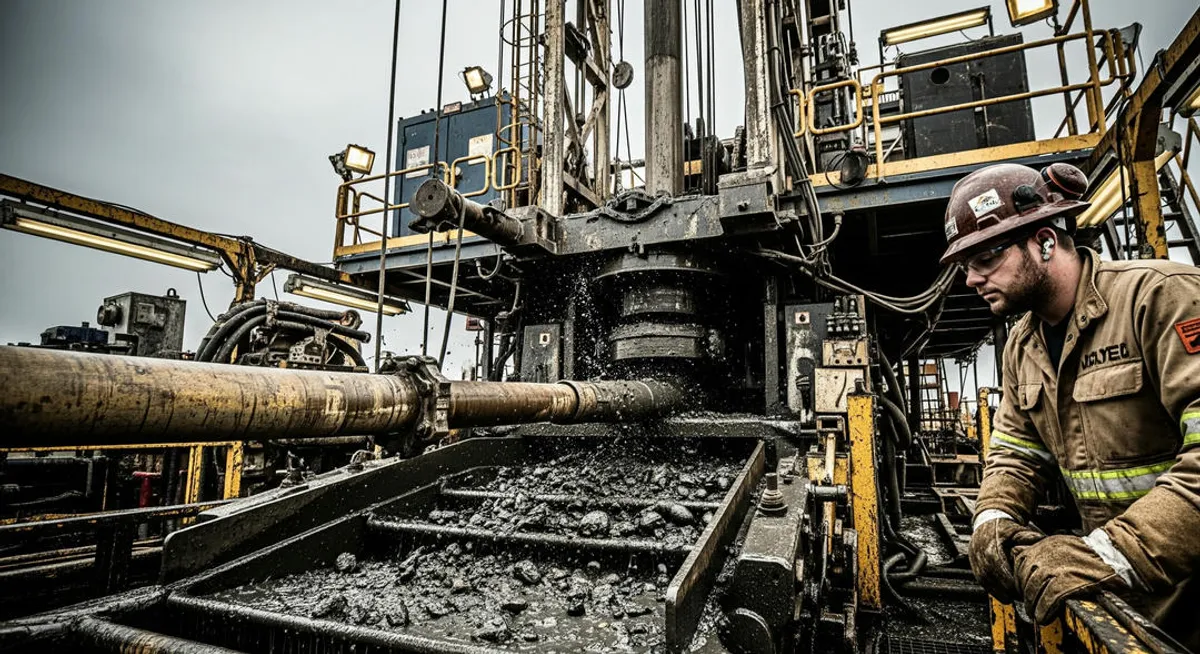
Support Teams: Mud Engineers, Cementing Specialists, and Wellsite Geologists
- Published August 3, 2025
Drilling a petroleum well is a collaborative effort that relies not only on primary equipment and operational hierarchy but also on specialized support teams that ensure technical success and safety. This chapter explores the critical roles of mud engineers, cementing specialists, and wellsite geologists, highlighting how their interdisciplinary collaboration optimizes drilling operations. These professionals integrate knowledge of geology, well design, and equipment to address challenges such as unstable formations or abnormal pressures, connecting to safety and sustainability.
Support Teams in Drilling
Support teams are essential for tackling the technical challenges of drilling, from designing drilling fluids to interpreting real-time geological data. Each role brings specialized expertise, working closely with the Company Man, Toolpusher, and Driller to ensure the well is constructed efficiently and safely. Interdisciplinary collaboration ensures decisions are based on accurate data and integrated solutions, minimizing risks like kicks or well collapses.
Mud Engineers
Mud engineers design, monitor, and adjust drilling fluid (mud), which is crucial for cooling the drill bit, removing cuttings, stabilizing the well, and controlling reservoir pressure. The mud can be water-based, oil-based, or synthetic, depending on the formation’s properties.
Responsibilities:
- Mud design: Formulate mud based on formation characteristics, such as reactive shales or abrasive sandstones. For example, in Vaca Muerta, an oil-based mud prevents clay swelling.
- Real-time monitoring: Analyze mud properties (density, viscosity, pH) during drilling, adjusting them to maintain well stability.
- Pressure control: Adjust mud density to counterbalance reservoir pressure, preventing kicks or circulation losses.
- Cuttings management: Ensure cuttings are efficiently removed, collaborating with the Driller to optimize circulation.
- Environmental compliance: Select muds that meet environmental regulations, minimizing site impact.
Collaboration: Work with the Driller to adjust parameters like mud flow and with the Company Man to report issues like circulation losses, ensuring technical decisions align with the AFE.
Cementing Specialists
Cementing specialists design and execute cementing operations, which seal the annular space between the casing and wellbore wall, isolating zones and protecting aquifers. This process is critical during the completion phase.
Responsibilities:
- Cement slurry design: Formulate cement mixtures based on well conditions, such as temperature and pressure. For example, in a deep well in the Gulf of Mexico, high-pressure-resistant cements are used.
- Cementing execution: Supervise cement injection, ensuring a uniform seal to prevent fluid migration.
- Integrity testing: Conduct pressure tests to verify seal quality, complying with regulations.
- Troubleshooting: Address issues like cement channeling, collaborating with the Toolpusher to adjust the plan.
- Sustainability: Select materials that minimize environmental impact, such as low-carbon cements.
Collaboration: Work with mud engineers to coordinate the transition from mud to cement and with the Company Man to ensure compliance with regulatory permits.
Wellsite Geologists
Wellsite geologists interpret real-time geological data to guide drilling, ensuring the well reaches the reservoir rock on the optimal trajectory. They use tools like MWD and LWD to analyze formations.
Responsibilities:
- Real-time analysis: Interpret log data (gamma ray, resistivity) to identify productive layers or risk zones, such as faults.
- Trajectory adjustment: Collaborate with the Driller to steer directional or multilateral wells, keeping the bit in the target zone.
- Hydrocarbon identification: Evaluate the presence of oil or gas, guiding decisions on production testing.
- Geological reporting: Provide reports to the Company Man to update the drilling plan, integrating data from geological maps.
- Risk management: Warn about unstable formations, like reactive shales, to prevent collapses or pipe sticking.
Collaboration: Work with mud engineers to correlate cuttings data with formation properties and with the Toolpusher to adjust operational parameters based on geological findings.
Interdisciplinary Collaboration
Collaboration between these teams is the core of a successful operation. For example, in a directional well in the Permian Basin:
- The wellsite geologist identifies a productive shale layer using LWD data, recommending trajectory adjustments.
- The mud engineer modifies fluid density to stabilize the formation, preventing collapses.
- The cementing specialist designs a slurry to ensure isolation of the productive zone during completion.
- The Company Man coordinates decisions, ensuring compliance with the AFE and regulations.
This integration reduces risks like kicks, circulation losses, or cementing failures, directly connecting to safety (upcoming topics).
The following table summarizes the roles and their collaboration:
| Role | Main Responsibilities | Key Collaboration | Example Task |
|---|---|---|---|
| Mud Engineer | Design and monitor mud, control pressure | Driller, Wellsite Geologist | Adjust mud density for shales |
| Cementing Specialist | Design and execute cementing, integrity tests | Mud Engineer, Company Man | Seal casing in deep well |
| Wellsite Geologist | Interpret data, guide trajectory, identify risks | Driller, Toolpusher, Company Man | Identify productive layer with LWD |
Summary
Support teams—mud engineers, cementing specialists, and wellsite geologists—are essential for drilling success, providing technical expertise that complements the operational hierarchy. Their interdisciplinary collaboration integrates geological data, engineering solutions, and regulatory compliance, optimizing well construction and minimizing risks. These roles connect geological fundamentals, well types, equipment, and the well lifecycle with safety and sustainability.
Practical Exercise
- Reflection question: Why do you think interdisciplinary collaboration between the mud engineer and wellsite geologist is crucial for preventing issues like well collapses?
- Research task: Investigate an oilfield (e.g., Eagle Ford) and write a paragraph describing how support teams contribute to drilling a well.
- Technical question: Explain how the mud engineer and cementing specialist work together during the transition from drilling to completion.
Bibliography
-
Books used:
- Hyne, N.J. (2012). Nontechnical Guide to Petroleum Geology, Exploration, Drilling & Production. PennWell Books.
Explains support roles in drilling in an accessible manner. - Bourgoyne, A.T., Millheim, K.K., Chenevert, M.E., & Young, F.S. (1986). Applied Drilling Engineering. SPE Textbook Series.
Details the responsibilities of mud engineers and cementing specialists.
- Hyne, N.J. (2012). Nontechnical Guide to Petroleum Geology, Exploration, Drilling & Production. PennWell Books.
-
Recommended books:
- Mitchell, R.F., & Miska, S.Z. (2011). Fundamentals of Drilling Engineering. SPE Textbook Series.
A technical resource on support teams and collaboration. Available at: https://store.spe.org/Fundamentals-of-Drilling-Engineering-P113.aspx. - Azar, J.J., & Samuel, G.R. (2007). Drilling Engineering. PennWell Books.
Ideal for deepening knowledge on mud and cementing. Available at: https://www.pennwellbooks.com/drilling-engineering/.
- Mitchell, R.F., & Miska, S.Z. (2011). Fundamentals of Drilling Engineering. SPE Textbook Series.
-
Direct links:
- SPE (Society of Petroleum Engineers): Resources on drilling support teams. https://www.spe.org/en/.
- IADC (International Association of Drilling Contractors): Information on technical roles in drilling. https://www.iadc.org/.
- PetroSkills: Courses on mud and cementing. https://www.petroskills.com/en/training/courses/drilling-fluids-technology---dft.