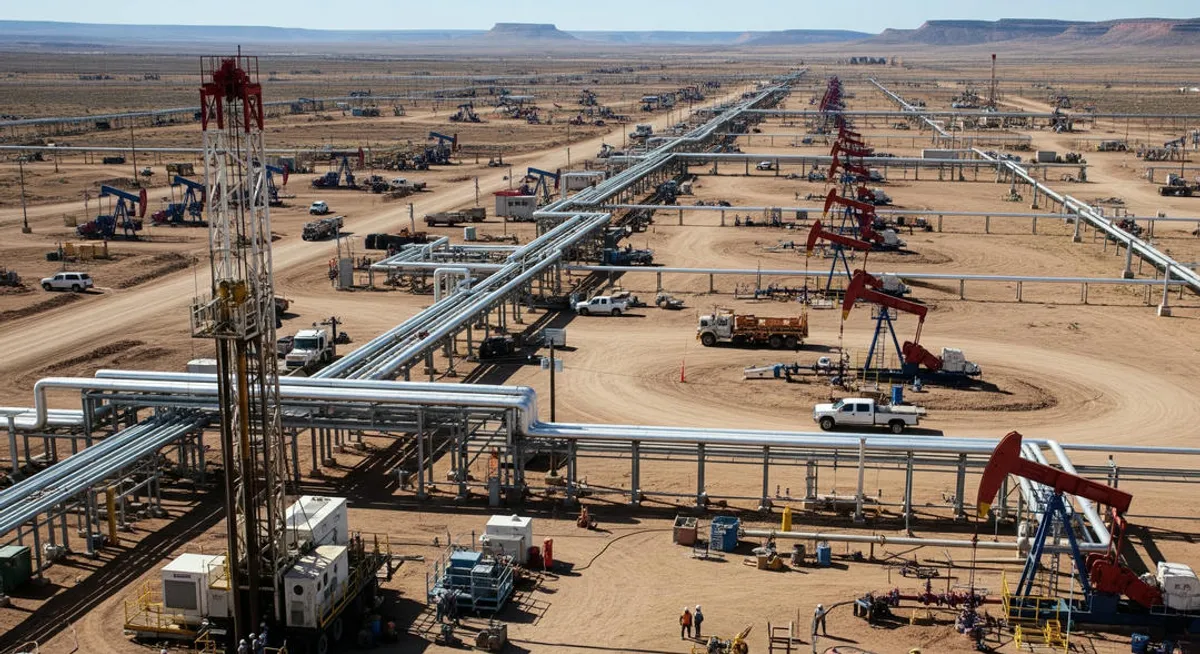
Petroleum Well: Definition, Purpose, and Lahee Classification
- Published August 2, 2025
A petroleum or gas well is much more than a simple hole in the ground; it is a precisely engineered system designed to explore, exploit, or manage subsurface resources. Its purpose and type determine the drilling strategies, equipment used, and risks involved. This chapter defines what a well is, explains its purpose in hydrocarbon extraction, and details the Lahee classification, which distinguishes between exploratory, development, and injection wells, among others. Understanding these concepts connects petroleum geology with the well lifecycle and drilling equipment, setting the stage for the more advanced technical topics to come.
Definition and Purpose of a Petroleum or Gas Well
A petroleum or gas well is a borehole drilled into the Earth’s crust to access a hydrocarbon reservoir—oil, natural gas, or both—and facilitate its extraction, evaluation, or management. Constructed with a drill string, casing, cement, and specialized fluids, the well acts as a conduit connecting the reservoir rock to surface facilities for production, storage, or transportation.
Wells serve various purposes, depending on the project phase and reservoir needs:
- Exploration: Confirm the presence of hydrocarbons in an unknown or understudied area, such as exploratory wells targeting new geological traps.
- Production: Efficiently extract hydrocarbons from the reservoir rock to the surface, maximizing economic recovery.
- Evaluation: Collect data on reservoir properties, such as pressure, porosity, or fluid composition, to plan field development.
- Reservoir management: Inject fluids, such as water or CO2, to maintain reservoir pressure or enhance recovery, as in injection wells.
- Emergency control: Intercept out-of-control wells (blowouts) through relief wells, diverting pressure to prevent disasters.
Each well is an integrated system where components like the drill bit, drilling fluid, and blowout preventers (BOPs) work together to ensure stability, safety, and efficiency. For example, in a well in Argentina’s Neuquén Basin, the design must account for the hardness of the Vaca Muerta formations to reach the reservoir rock without collapsing.
Lahee Classification
The Lahee classification, developed by the American Association of Petroleum Geologists (AAPG), categorizes wells based on their purpose and risk level, providing a standard framework for the industry. This classification is particularly useful for assessing the economic and technical potential of a drilling project. The main types of wells under the Lahee classification are:
Exploratory Wells
Exploratory wells, also known as wildcat wells, are drilled in areas with little or no prior geological data, aiming to discover new reservoirs. These wells are high-risk, as the likelihood of finding commercial hydrocarbons is low (often less than 20%). However, a successful well can transform a region, as seen with the Spindletop discovery in 1901.
Exploratory wells are divided into subtypes:
- Wildcat: Drilled in areas with no known production, such as a prospect in an unexplored basin.
- New Field Wildcat: Seek a new reservoir in a region with some nearby production.
- New Pool Wildcat: Target a new productive layer within a known field.
For example, a wildcat in Brazil’s Santos Basin might target oil in a stratigraphic trap identified by seismic data. These wells require detailed geological analysis and are often the most expensive due to uncertainty.
Development Wells
Development wells are drilled in confirmed reservoirs to efficiently extract hydrocarbons. These wells have lower risk, as they rely on data from prior exploratory wells, such as seismic logs or production tests. Their purpose is to maximize reservoir recovery, either by drilling additional wells or extending the field’s productive life.
For example, in Saudi Arabia’s Ghawar field, development wells are drilled in regular patterns to optimize oil extraction from a carbonate reservoir rock. These wells can be vertical, directional, or horizontal, depending on the reservoir’s geometry.
Injection Wells
Injection wells are used to inject fluids, such as water, gas, or chemicals, into the reservoir to maintain pressure or enhance hydrocarbon recovery. They are common in mature fields where natural pressure has declined. For example, in Venezuela’s Maracaibo field, water injection wells help push oil toward producing wells, increasing output.
Other uses include CO2 injection for carbon capture and storage (CCS), an increasingly relevant approach in the energy transition. These wells require careful design to avoid fracturing the reservoir rock or contaminating aquifers, connecting to formation properties.
The following table summarizes the Lahee classification:
| Well Type | Purpose | Risk Level | Example |
|---|---|---|---|
| Exploratory (Wildcat) | Discover new reservoirs | High | Well in an unexplored basin |
| Development | Extract hydrocarbons from known reservoirs | Low | Well in Ghawar field |
| Injection | Maintain pressure or enhance recovery | Medium | Water injection in Maracaibo |
Summary
A petroleum well is an engineered system designed to explore, extract, or manage hydrocarbons, with purposes ranging from reservoir confirmation to emergency control. The Lahee classification organizes wells into exploratory, development, and injection types, reflecting their risk and objective. These concepts connect petroleum geology with the well lifecycle and well types, providing a foundation for understanding how drilling operations are planned and executed.
Practical Exercise
- Reflection question: Why do you think exploratory wells have such high risk, and how might this influence the decision to drill one?
- Research task: Investigate a known oilfield (e.g., Permian Basin) and write a paragraph describing which types of wells (exploratory, development, or injection) are used and their purpose.
- Technical question: Explain how an injection well contributes to hydrocarbon recovery in a mature reservoir.
Bibliography
-
Books used:
- Hyne, N.J. (2012). Nontechnical Guide to Petroleum Geology, Exploration, Drilling & Production. PennWell Books.
Explains well definition, purpose, and classification in an accessible manner. - Bourgoyne, A.T., Millheim, K.K., Chenevert, M.E., & Young, F.S. (1986). Applied Drilling Engineering. SPE Textbook Series.
Details well types and their application in the industry.
- Hyne, N.J. (2012). Nontechnical Guide to Petroleum Geology, Exploration, Drilling & Production. PennWell Books.
-
Recommended books:
- Selley, R.C., & Sonnenberg, S.A. (2014). Elements of Petroleum Geology. Academic Press.
A technical resource on well classification and its relation to reservoirs. Available at: https://www.elsevier.com/books/elements-of-petroleum-geology/selley/978-0-12-386031-6. - Mitchell, R.F., & Miska, S.Z. (2011). Fundamentals of Drilling Engineering. SPE Textbook Series.
Ideal for connecting wells with drilling operations. Available at: https://store.spe.org/Fundamentals-of-Drilling-Engineering-P113.aspx.
- Selley, R.C., & Sonnenberg, S.A. (2014). Elements of Petroleum Geology. Academic Press.
-
Direct links:
- SPE (Society of Petroleum Engineers): Resources on well types. https://www.spe.org/en/.
- AAPG (American Association of Petroleum Geologists): Information on the Lahee classification. https://www.aapg.org/.
- PetroSkills: Courses on drilling fundamentals. https://www.petroskills.com/en/training/courses/drilling-practices---dp.