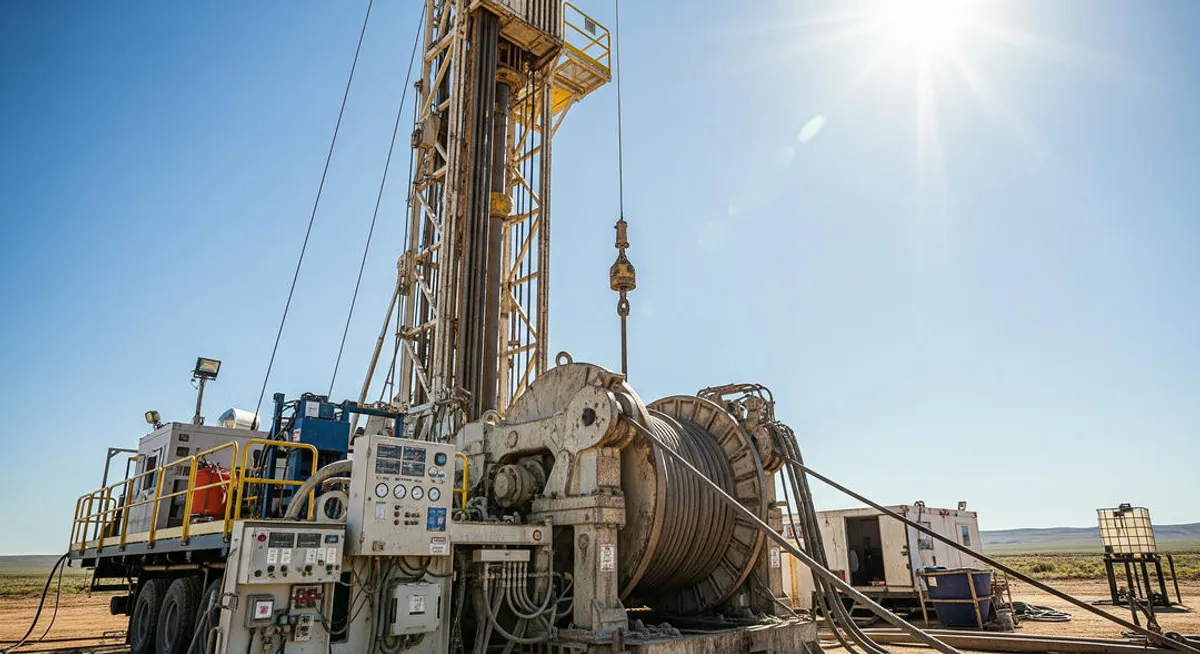
Onshore Drilling Equipment: Conventional Rigs and Workover Rigs
- Published August 2, 2025
Onshore drilling is the backbone of the petroleum industry in many regions, utilizing robust equipment designed to operate in terrestrial environments, from deserts to sedimentary basins. This chapter explores the two main types of onshore drilling equipment: conventional rigs, used for drilling new wells, and workover units, designed for maintaining or enhancing existing wells. We will focus on key components, such as the mast and drawworks, which are essential for these rigs’ operations. Understanding these systems connects geological concepts, well types, and the well lifecycle with offshore operations and rig organization.
Conventional Rigs
Conventional rigs, also known as rotary rigs, are the standard equipment for drilling new wells in onshore environments. Designed to handle vertical, directional, or multilateral wells, these rigs integrate mechanical, hydraulic, and electrical systems to drill through geological formations and reach hydrocarbon reservoirs. Their modular structure allows for transportation and assembly at the drilling site, adapting to various terrain conditions.
Key Components of Conventional Rigs
-
Mast or Drilling Tower
The mast is the vertical structure that supports the weight of the drill string and lifting equipment. Made of high-strength steel, it can reach heights of 30 to 50 meters, depending on the well’s depth. The mast holds the top drive or rotary table, which rotate the drill string, and the traveling block, which facilitates vertical movement. For example, in a well in the Permian Basin, a robust mast is crucial for handling long drill strings in deep horizontal wells. -
Drawworks
The drawworks is the primary lifting system, consisting of a drum and steel cables that raise or lower the drill string. Powered by electric or diesel motors, the drawworks adjusts speed and force to handle heavy loads, such as adding pipe sections or pulling the drill string. Its design includes safety brakes to prevent drops, especially in hard formations like limestones. -
Rotation System
Includes the rotary table or top drive, which provides the rotation needed for the bit to cut through rock. The top drive is more common in modern rigs, offering greater control and efficiency, especially in directional wells. -
Mud Circulation System
Mud pumps, tanks, and hoses circulate drilling fluid, which cools the bit, removes cuttings, and stabilizes the well. In a well in Vaca Muerta, the mud system is critical for managing reactive shales. -
Blowout Preventers (BOPs)
BOPs are safety valves that seal the well in case of a kick, protecting personnel and equipment. They are essential in all drilling phases.
Applications:
Conventional rigs are used for exploratory and development wells in onshore reservoirs, such as in the Neuquén Basin or Eagle Ford. They are versatile, adapting to soft (sandstones) or hard (limestones) formations and can drill wells up to 10,000 meters with the right equipment.
Advantages:
- Flexibility: Suitable for vertical and directional wells.
- Mobility: Modular rigs are easily transported between locations.
- Moderate cost: Less expensive than offshore equipment.
Challenges:
- Limited by terrain access (e.g., in remote or mountainous areas).
- Require constant maintenance to prevent failures in the mast or drawworks.
Workover Units
Workover units are specialized equipment designed to intervene in existing wells for maintenance, repair, or production enhancement. Unlike conventional rigs, which drill new wells, workover units operate on wells in the production or completion phase. They are more compact and lightweight, making them ideal for quick operations in mature fields.
Key Components of Workover Units
-
Mast
Similar to that of conventional rigs but smaller and lighter, designed to handle shorter drill strings or intervention tools, such as progressive cavity pumps or artificial lift systems. In a well in the Maracaibo field, the mast supports cleaning or pipe replacement operations. -
Drawworks
The workover unit’s drawworks is more compact, capable of handling lighter loads, such as wireline or coiled tubing. It enables precise operations, like installing plugs or clearing obstructions. -
Well Control System
Includes smaller BOPs or pressure control systems specific to interventions, ensuring safety during operations in active wells. -
Intervention Equipment
Includes tools like wireline for logging or coiled tubing for cleaning, allowing tasks to be performed without fully dismantling the well.
Applications:
- Maintenance: Clearing paraffin or sand deposits in producing wells.
- Repairs: Replacing damaged pipes or production pumps.
- Production enhancement: Hydraulic fracturing or stimulation in low-productivity wells, such as in Eagle Ford.
- Partial abandonment: Installing plugs in non-productive zones.
Advantages:
- Efficiency: Quick interventions without the need for a full rig.
- Cost-effective: Less expensive than drilling a new well.
- Versatility: Suitable for vertical and directional wells.
Challenges:
- Limited to existing wells, cannot drill new ones.
- Lower capacity for handling high pressures or deep wells.
The following table compares conventional rigs and workover units:
| Equipment | Purpose | Key Components | Advantages | Challenges |
|---|---|---|---|---|
| Conventional Rig | Drill new wells | Mast, drawworks, top drive, BOP | Flexibility, depth capability | High costs, terrain access |
| Workover Unit | Maintain/repair existing wells | Compact mast, light drawworks | Low cost, speed | Limited to existing wells |
Summary
Conventional rigs and workover units are the backbone of onshore drilling, each with specific roles in the well lifecycle. Conventional rigs drill new wells, using components like the mast and drawworks to handle complex formations, while workover units optimize existing wells with quick interventions. These systems connect geological fundamentals and well types with offshore operations and rig organization.
Practical Exercise
- Reflection question: Why do you think conventional rigs are more versatile than workover units, and how does this affect their use in an oilfield?
- Research task: Investigate an onshore field (e.g., Vaca Muerta) and write a paragraph describing how conventional rigs or workover units are used in its operations.
- Technical question: Explain the role of the drawworks in a conventional rig and how it differs in a workover unit.
Bibliography
-
Books used:
- Hyne, N.J. (2012). Nontechnical Guide to Petroleum Geology, Exploration, Drilling & Production. PennWell Books.
Explains onshore drilling equipment in an accessible manner. - Bourgoyne, A.T., Millheim, K.K., Chenevert, M.E., & Young, F.S. (1986). Applied Drilling Engineering. SPE Textbook Series.
Details the components and operation of rigs and workover units.
- Hyne, N.J. (2012). Nontechnical Guide to Petroleum Geology, Exploration, Drilling & Production. PennWell Books.
-
Recommended books:
- Mitchell, R.F., & Miska, S.Z. (2011). Fundamentals of Drilling Engineering. SPE Textbook Series.
A technical resource on drilling equipment. Available at: https://store.spe.org/Fundamentals-of-Drilling-Engineering-P113.aspx. - Azar, J.J., & Samuel, G.R. (2007). Drilling Engineering. PennWell Books.
Ideal for deepening knowledge on conventional rigs and workover units. Available at: https://www.pennwellbooks.com/drilling-engineering/.
- Mitchell, R.F., & Miska, S.Z. (2011). Fundamentals of Drilling Engineering. SPE Textbook Series.
-
Direct links:
- SPE (Society of Petroleum Engineers): Resources on drilling equipment. https://www.spe.org/en/.
- IADC (International Association of Drilling Contractors): Information on rigs and workover units. https://www.iadc.org/.
- PetroSkills: Courses on onshore drilling operations. https://www.petroskills.com/en/training/courses/drilling-practices---dp.