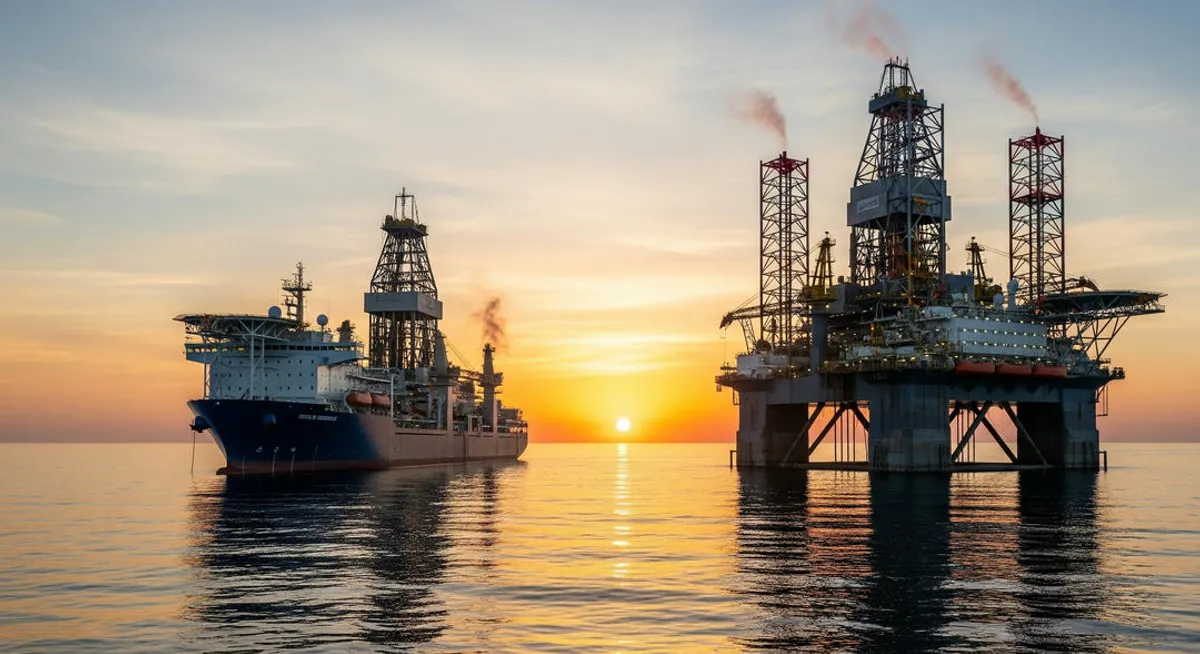
Offshore Equipment II: Semi-submersibles and Drillships
- Published August 2, 2025
Deepwater drilling has transformed the petroleum industry, enabling access to reservoirs at depths exceeding 500 meters, where fixed platforms and jack-ups are not viable. This chapter focuses on equipment designed for these extreme conditions: semi-submersibles and drillships. We will explore their components, applications, and the critical role of dynamic positioning (DP) in ensuring stability and precision during operations. These concepts connect geology, well types, and onshore/offshore equipment with rig organization and safety measures.
Semi-submersibles
Semi-submersibles are floating platforms designed to operate in deep waters, from 200 to over 3,000 meters. Their partially submerged structure, with water-filled pontoons and columns supporting the deck, provides stability against waves and storms, while anchoring or dynamic positioning maintains their position.
Key Components
-
Pontoons and Columns
The pontoons, submerged underwater, provide buoyancy, while the columns connect the pontoons to the upper deck, elevating it above the waves. This design minimizes the impact of marine conditions, as seen in the North Sea. -
Deck
The deck houses the drilling rig, with components similar to onshore rigs: derrick, drawworks, top drive, and mud pumps. It also includes crew accommodations and control systems. -
Drilling System
Includes a top drive to rotate the drill string, subsea blowout preventers (BOPs), and a riser (a pipe connecting the seabed well to the platform) for circulating drilling mud. -
Positioning System
Semi-submersibles use anchors (chains or cables) or dynamic positioning (DP), which combines thrusters, sensors, and GPS to keep the platform in position, even during storms.
Applications
- Deepwater drilling: Used in basins like Brazil’s Santos Basin to access pre-salt reservoirs at over 2,000 meters deep.
- Exploratory and development wells: Ideal for directional and multilateral wells in complex marine environments.
- Extreme conditions: Their stability makes them suitable for regions with rough seas, such as the Gulf of Mexico during hurricanes.
Limitations
- High cost: Construction and operation are more expensive than fixed platforms or jack-ups.
- Limited mobility: Although movable, the process is slower than with drillships.
- DP dependency: In ultra-deep waters, DP is critical but requires redundant systems to prevent failures.
Drillships
Drillships are vessels equipped with drilling systems, designed to operate in ultra-deep waters (up to 4,000 meters or more). Their maritime design allows for high mobility, and dynamic positioning is essential for maintaining stability during drilling.
Key Components
-
Ship Hull
The hull, similar to a ship’s, houses the drilling rig and support systems, with space for crew accommodations, mud storage, and fuel. Its streamlined design facilitates long-distance transport. -
Drilling System
Includes a derrick, top drive, drawworks, and subsea BOPs, connected to the well via a riser. Modern drillships integrate MWD and LWD systems for precise directional drilling. -
Dynamic Positioning (DP)
DP uses computer-controlled thrusters, GPS, and sensors to maintain the vessel’s position without anchors. This is crucial in deep waters, where currents and winds are challenging. -
Power Systems
Diesel-electric generators power the drilling rig, thrusters, and support systems, ensuring continuous operations offshore.
Applications
- Ultra-deepwater exploration: Used in regions like the Gulf of Guinea or the Arctic, where reservoirs are at over 3,000 meters.
- Complex wells: Ideal for multilateral wells in pre-salt or compartmentalized reservoirs.
- Global mobility: Their navigational capability allows exploration of multiple basins without disassembling equipment.
Limitations
- Operational cost: Drillships are the most expensive equipment, with daily rates that can exceed $500,000.
- Stability: Less stable than semi-submersibles in rough seas, relying entirely on DP.
- Cargo capacity: Limited storage space for materials compared to fixed platforms.
Dynamic Positioning (DP) and Deepwater Operations
Dynamic positioning (DP) is a critical technology for semi-submersibles and drillships, enabling precise positioning over the well without physical anchors. It uses computer-controlled thrusters that process data from GPS, wind sensors, currents, and vessel motion. In a drillship operating in Brazil’s Campos Basin, DP adjusts thrusters in real-time to counteract deep currents, ensuring the riser remains aligned with the well.
Advantages of DP:
- Flexibility: Enables operations in ultra-deep waters (>2,000 meters), where anchors are impractical.
- Speed: Facilitates repositioning without installing or removing anchors.
- Precision: Keeps the equipment within a few meters of the target, crucial for directional wells.
Challenges of DP:
- Energy consumption: Requires redundant generators to prevent failures, increasing costs.
- Risk of failure: A DP system error can lead to riser disconnection, causing downtime or accidents.
- Training: Operators need specialized training to manage DP in extreme conditions.
In deepwater operations, such as in the Gulf of Mexico, DP enables drilling wells at over 3,000 meters, accessing pre-salt reservoirs with stratigraphic traps. However, DP dependency requires robust backup systems and rigorous emergency plans.
The following table compares semi-submersibles and drillships:
| Equipment | Maximum Depth | Advantages | Limitations | Applications |
|---|---|---|---|---|
| Semi-submersible | ~3,000 m+ | Stability, capacity in rough seas | High cost, limited mobility | Deep waters, extreme conditions |
| Drillship | ~4,000 m+ | High mobility, global exploration | Less stable, very high cost | Ultra-deep waters, complex wells |
Summary
Semi-submersibles and drillships are the most advanced equipment for offshore drilling in deep waters, overcoming the depth limitations of fixed platforms and jack-ups. Dynamic positioning (DP) is crucial for their operation, ensuring precision in extreme environments. These systems connect geological fundamentals, well types, and onshore/offshore equipment with rig organization and safety measures.
Practical Exercise
- Reflection question: How do you think dynamic positioning (DP) impacts the economic viability of a project in ultra-deep waters?
- Research task: Investigate a deepwater field (e.g., Santos Basin) and write a paragraph describing whether semi-submersibles or drillships are used and why.
- Technical question: Explain how the riser system and dynamic positioning work together to maintain stability in a drillship.
Bibliography
-
Books used:
- Hyne, N.J. (2012). Nontechnical Guide to Petroleum Geology, Exploration, Drilling & Production. PennWell Books.
Explains offshore equipment and dynamic positioning in an accessible manner. - Bourgoyne, A.T., Millheim, K.K., Chenevert, M.E., & Young, F.S. (1986). Applied Drilling Engineering. SPE Textbook Series.
Details the components and operation of semi-submersibles and drillships.
- Hyne, N.J. (2012). Nontechnical Guide to Petroleum Geology, Exploration, Drilling & Production. PennWell Books.
-
Recommended books:
- Mitchell, R.F., & Miska, S.Z. (2011). Fundamentals of Drilling Engineering. SPE Textbook Series.
A technical resource on deepwater offshore equipment. Available at: https://store.spe.org/Fundamentals-of-Drilling-Engineering-P113.aspx. - Azar, J.J., & Samuel, G.R. (2007). Drilling Engineering. PennWell Books.
Ideal for deepening knowledge on semi-submersibles and drillships. Available at: https://www.pennwellbooks.com/drilling-engineering/.
- Mitchell, R.F., & Miska, S.Z. (2011). Fundamentals of Drilling Engineering. SPE Textbook Series.
-
Direct links:
- SPE (Society of Petroleum Engineers): Resources on deepwater drilling. https://www.spe.org/en/.
- IADC (International Association of Drilling Contractors): Information on semi-submersibles and drillships. https://www.iadc.org/.
- PetroSkills: Courses on deepwater offshore operations. https://www.petroskills.com/en/training/courses/offshore-drilling---od.