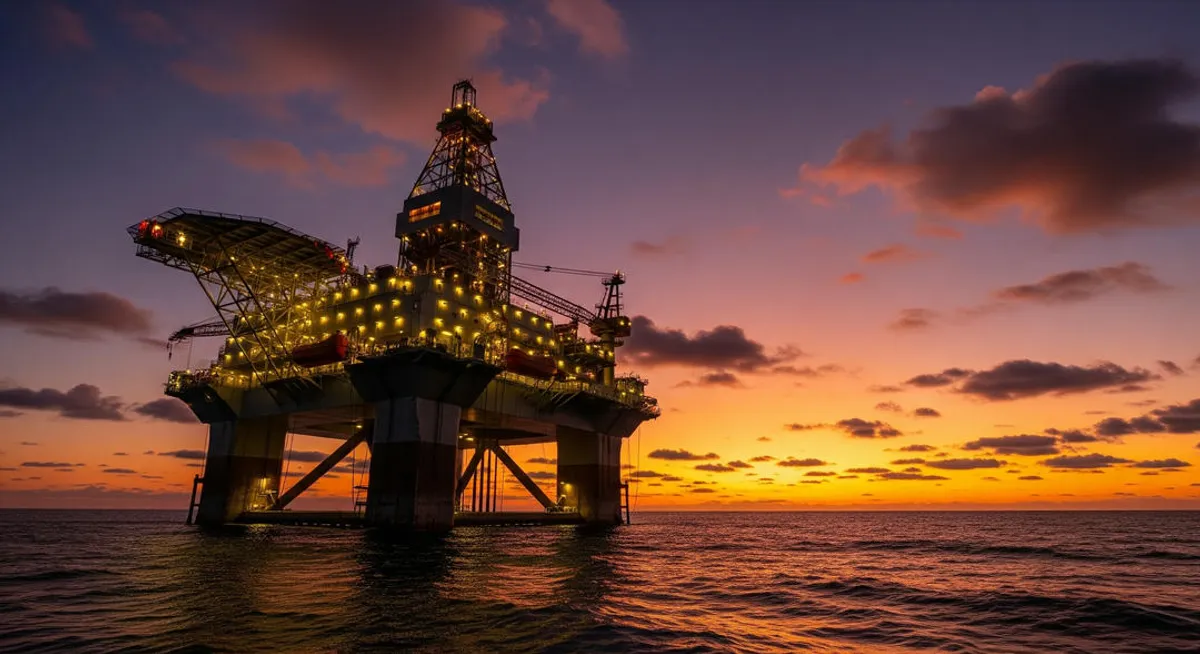
Offshore Equipment: Fixed Platforms and Jack-ups
- Published August 2, 2025
Offshore drilling has enabled the petroleum industry to access reservoirs beneath the seabed, opening new frontiers in regions like the Gulf of Mexico, the North Sea, and the Santos Basin. This chapter focuses on two key types of offshore equipment: fixed platforms and jack-ups, designed to operate in shallow to moderate waters. We will explore their components, applications, and limitations in terms of depth and stability, connecting geological fundamentals, well types, and onshore equipment with advanced deepwater drilling systems and rig organization.
Fixed Platforms
Fixed platforms are structures anchored directly to the seabed, designed to drill and produce hydrocarbons in shallow waters, typically up to 150 meters deep. Constructed from steel or concrete, these platforms are permanently installed at the drilling site and are common in coastal regions with conventional reservoirs.
Key Components
-
Support Structure (Jacket)
The jacket is a steel framework anchored to the seabed with piles, supporting the upper deck where drilling equipment is located. Its design withstands waves, currents, and drilling loads, as seen in platforms in the Gulf of Mexico. -
Deck
The deck houses the drilling rig, which includes components similar to those of a conventional onshore rig, such as the derrick, drawworks, and top drive. It also contains crew accommodations and offices. -
Drilling System
Similar to onshore rigs, it includes a top drive or rotary table, mud pumps, and subsea blowout preventers (BOPs), adapted for underwater operation. The BOPs are installed on the seabed to control well pressure. -
Anchoring System
Piles, driven deep into the seabed, ensure the platform’s stability against storms and marine currents.
Applications
- Exploratory and development wells: Fixed platforms are used to drill multiple wells from a single location, such as in Mexico’s Cantarell field, where they access carbonate reservoirs.
- Long-term production: Once drilled, wells are connected to production systems on the platform, processing and transporting hydrocarbons.
- Coastal regions: Ideal for shallow waters in basins like the Gulf of Mexico or the Caspian Sea.
Limitations
- Depth: Limited to waters up to 150 meters, as taller structures are costly and less stable.
- Stability: Vulnerable to hurricanes or extreme storms, which can damage the jacket or deck.
- Mobility: Cannot be relocated, making them unsuitable for exploration in multiple locations.
Jack-ups
Jack-ups are mobile platforms with extendable legs that anchor to the seabed, designed to operate in waters up to 150-180 meters deep. These units are towed to the drilling site, where the legs are lowered to the seabed, raising the hull above the water surface for stability.
Key Components
-
Legs and Lifting System
The legs, typically three or four, are made of steel and extend to the seabed. A hydraulic or electric system raises or lowers them, adjusting the hull height. For example, in the North Sea, jack-up legs anchor in sandy or clayey soils. -
Hull
The hull houses the drilling rig, crew accommodations, and support systems. It floats during transport and is raised above the water during drilling, enhancing stability against waves. -
Drilling System
Similar to fixed platforms, it includes a derrick, drawworks, top drive, and subsea BOPs. The compact design optimizes space on the hull. -
Power and Support Systems
Diesel or electric generators power the rig and lifting systems, while accommodations support 12-hour crew shifts.
Applications
- Mobile exploration: Jack-ups are ideal for exploratory (wildcat) wells in multiple locations, such as in the Gulf of Mexico.
- Drilling in moderate waters: Used in basins with depths of 50-180 meters, like the Java Sea.
- Directional wells: Their ability to drill complex trajectories makes them versatile for extensive reservoirs.
Limitations
- Depth: Cannot operate in deep waters (>180 meters), where semi-submersibles or drillships are required.
- Stability: Sensitive to soft or uneven seabed soils, which can cause instability or leg subsidence.
- Setup time: Anchoring and raising the hull can take days, increasing non-productive time.
The following table compares fixed platforms and jack-ups:
| Equipment | Maximum Depth | Advantages | Limitations | Applications |
|---|---|---|---|---|
| Fixed Platform | ~150 m | Stability, long-term production | Immobility, storm vulnerability | Coastal fields, continuous production |
| Jack-up | ~180 m | Mobility, exploration versatility | Depth limitation, soft seabed issues | Exploration, directional wells |
Summary
Fixed platforms and jack-ups are essential for offshore drilling in shallow to moderate waters, each with specific advantages and limitations. Fixed platforms offer stability for long-term production, while jack-ups excel in exploration due to their mobility. Their depth and stability limitations distinguish them from deepwater equipment, connecting geological fundamentals, well types, and onshore equipment with marine operations and rig organization.
Practical Exercise
- Reflection question: Why do you think the mobility of jack-ups makes them ideal for exploration, and how does this affect the costs of an offshore project?
- Research task: Investigate an offshore field (e.g., Gulf of Mexico) and write a paragraph describing whether fixed platforms or jack-ups are used and why.
- Technical question: Explain how the legs of a jack-up contribute to its stability, and what issues might arise in soft seabed soils.
Bibliography
-
Books used:
- Hyne, N.J. (2012). Nontechnical Guide to Petroleum Geology, Exploration, Drilling & Production. PennWell Books.
Explains offshore equipment, including fixed platforms and jack-ups, in an accessible manner. - Bourgoyne, A.T., Millheim, K.K., Chenevert, M.E., & Young, F.S. (1986). Applied Drilling Engineering. SPE Textbook Series.
Details the components and limitations of offshore equipment.
- Hyne, N.J. (2012). Nontechnical Guide to Petroleum Geology, Exploration, Drilling & Production. PennWell Books.
-
Recommended books:
- Mitchell, R.F., & Miska, S.Z. (2011). Fundamentals of Drilling Engineering. SPE Textbook Series.
A technical resource on offshore equipment. Available at: https://store.spe.org/Fundamentals-of-Drilling-Engineering-P113.aspx. - Azar, J.J., & Samuel, G.R. (2007). Drilling Engineering. PennWell Books.
Ideal for deepening knowledge on fixed platforms and jack-ups. Available at: https://www.pennwellbooks.com/drilling-engineering/.
- Mitchell, R.F., & Miska, S.Z. (2011). Fundamentals of Drilling Engineering. SPE Textbook Series.
-
Direct links:
- SPE (Society of Petroleum Engineers): Resources on offshore drilling. https://www.spe.org/en/.
- IADC (International Association of Drilling Contractors): Information on offshore equipment. https://www.iadc.org/.
- PetroSkills: Courses on offshore operations. https://www.petroskills.com/en/training/courses/offshore-drilling---od.