History of Petroleum and Gas, From Early Wells to the Modern Era
- Published July 15, 2024
The petroleum and gas industry has transformed the world, driving industrial revolutions, global economies, and technological advancements. From the first manually drilled wells to high-tech offshore platforms, its history is a chronicle of innovation and adaptation to geological, economic, and environmental challenges. This chapter takes you through the origins of this industry, highlighting foundational events like the Spindletop well and the impact of pioneering companies like Standard Oil, along with the technological milestones that have shaped its evolution. Understanding this history is the first step to connecting the geological and technical fundamentals explored in subsequent chapters.
Origins of the Petroleum and Gas Industry
The use of petroleum dates back to antiquity, when civilizations like the Babylonians used it to seal boats or light lamps. However, the modern industry was born in the 19th century, driven by the growing demand for fuels during the Industrial Revolution. The milestone that marked the beginning of this era was the drilling of the first commercial well in 1859 in Titusville, Pennsylvania, by Edwin Drake. Using a cable-tool drilling method, Drake reached a depth of 21 meters and extracted oil systematically, sparking an oil rush in the United States.
This success attracted investors and entrepreneurs, laying the foundation for an industry that soon expanded globally. In the following decades, oilfields were discovered in regions like the Russian Caucasus, the Middle East, and Latin America. Pioneering companies emerged to capitalize on this new source of wealth, with Standard Oil, founded by John D. Rockefeller in 1870, being one of the most influential. Standard Oil dominated oil production, refining, and distribution in the United States, establishing a vertically integrated model that influenced the structure of modern oil companies. However, its monopoly led to antitrust regulations in 1911, breaking it into companies like Exxon and Chevron.
The industry’s growth was not without challenges. Early wells were shallow, and drilling methods were rudimentary, with limited knowledge of geological formations or subsurface pressures. Blowouts, explosions caused by the uncontrolled release of hydrocarbons, were common and dangerous, highlighting the need for technological advancements to improve safety and efficiency.
Technological Milestones in Drilling
The evolution of oil drilling is a story of technological innovation, driven by the need to reach deeper and more complex reservoirs. Below are the most significant advancements, from early methods to modern offshore operations.
Cable-Tool Drilling and the Shift to Rotary Drilling
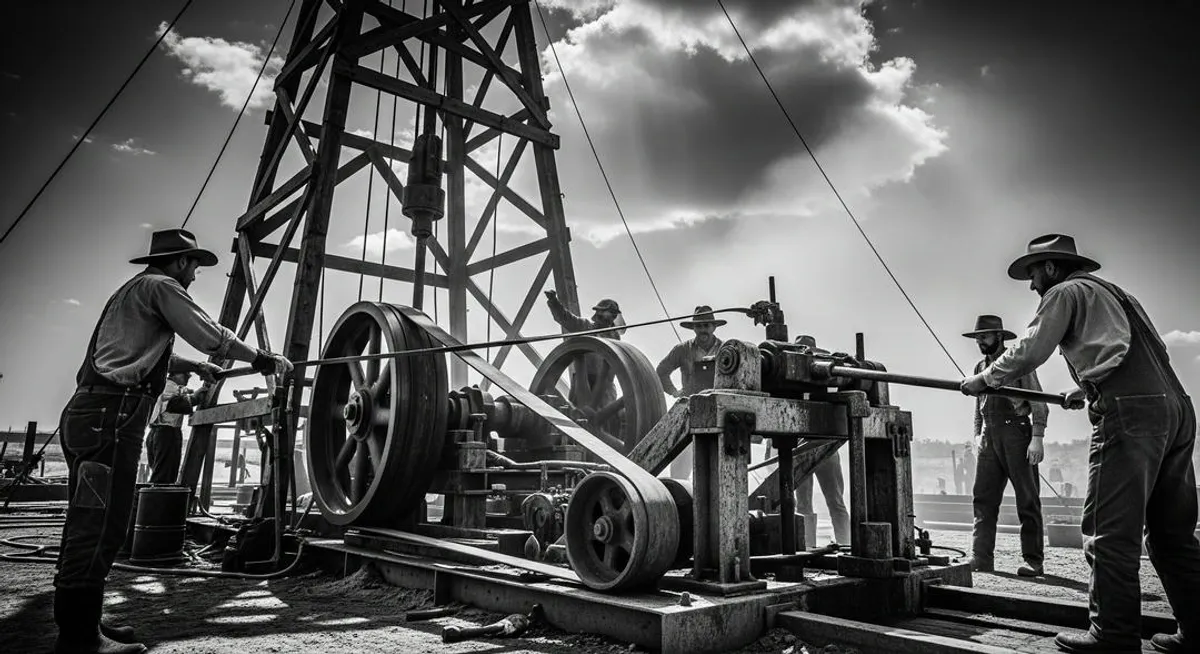
In the early days, cable-tool drilling dominated. This method used a cable and pulleys to lift and drop a heavy bit that fractured the rock, a slow process that could take months to drill a shallow well. While effective for hard formations, it was inefficient for soft rocks or deep wells.
The turning point came in 1901 with the Spindletop well in Texas, which marked the adoption of rotary drilling. This method uses a continuously rotating bit to cut through rock, while a drilling fluid (mud) circulates to cool the bit, remove cuttings, and control well pressure. Spindletop not only demonstrated the effectiveness of rotary drilling but also discovered a massive reservoir, producing 100,000 barrels per day and establishing Texas as an oil hub. Rotary drilling enabled deeper wells in less time, transforming the industry.
20th Century Advancements
The 20th century brought a series of innovations that defined modern drilling. In 1909, Howard Hughes Sr. invented the tricone bit, with rotating steel or tungsten carbide cones, improving efficiency across a wide range of formations. In the 1920s, blowout preventers (BOPs) were introduced as a critical safety device, sealing the well to control pressure and prevent disasters.
Offshore drilling marked another major milestone. In the 1930s, the first wells were drilled in shallow waters from fixed platforms in the Gulf of Mexico. In the 1950s, jack-ups and floating units, such as semi-submersibles, enabled exploration in deeper waters. The introduction of drillships in the 1960s, equipped with dynamic positioning systems, opened the door to drilling in ultra-deep waters, such as Brazil’s pre-salt fields.
The Modern Era: Automation and Offshore
In the late 20th century, directional and horizontal drilling revolutionized the industry, allowing access to reservoirs under vertically inaccessible areas, such as cities or lakes. Tools like measurement-while-drilling (MWD) and logging-while-drilling (LWD) systems improved precision, especially in unconventional wells like shale gas. The introduction of the top drive in the 1980s replaced the rotary table, offering greater control and efficiency in drill string rotation.
In the modern era, automation has transformed operations. Rigs equipped with sensors and software analyze real-time data, optimizing parameters like the rate of penetration (ROP) and reducing non-productive time. Offshore drilling in deep waters, supported by dynamic positioning systems, enables operations in extreme environments like the North Sea. Additionally, the industry has begun adapting to the energy transition, with drilling playing a role in carbon capture and storage (CCS) and geothermal energy projects.
The following table summarizes the key technological milestones:
| Technological Milestone | Year | Description | Impact |
|---|---|---|---|
| Cable-Tool Drilling | 1859 | Bit fractures rock using cable and pulleys | Initiated the industry, but slow and limited |
| Rotary Drilling | 1901 | Rotating bit with mud for cooling and cleaning | Greater depth and speed |
| Tricone Bit | 1909 | Cones with teeth for various formations | Improved drilling efficiency |
| Blowout Preventers | 1920s | Devices to control well pressure | Enhanced safety, prevented blowouts |
| Offshore Drilling | 1930s | Wells in shallow waters from platforms | Expanded exploration to marine environments |
| Top Drive | 1980s | More efficient rotation system than rotary table | Greater control and speed in drilling |
Summary
The petroleum and gas industry began with Edwin Drake’s well in 1859, evolving from manual methods to advanced technologies that enable drilling in ultra-deep waters and unconventional reservoirs. Milestones like Spindletop, rotary drilling, and offshore development have expanded exploration boundaries, while companies like Standard Oil laid the foundation for the modern industry. These historical advancements set the stage for the technical topics of the course, such as petroleum geology and drilling equipment.
Practical Exercise
- Reflection question: How do you think the Spindletop discovery changed the global perception of oil as an energy resource?
- Research task: Investigate the impact of Standard Oil on the petroleum industry and write a paragraph explaining how its business model influenced modern oil companies.
- Technical question: Describe how the introduction of rotary drilling improved efficiency compared to cable-tool drilling.
Bibliography
-
Books used:
- Azar, J.J., & Samuel, G.R. (2007). Drilling Engineering. PennWell Books.
Details the technological evolution of drilling, including milestones like rotary drilling. - Bourgoyne, A.T., Millheim, K.K., Chenevert, M.E., & Young, F.S. (1986). Applied Drilling Engineering. SPE Textbook Series.
Provides historical context on the origins of the petroleum industry.
- Azar, J.J., & Samuel, G.R. (2007). Drilling Engineering. PennWell Books.
-
Recommended books:
- Mitchell, R.F., & Miska, S.Z. (2011). Fundamentals of Drilling Engineering. SPE Textbook Series.
A comprehensive resource on the history and technology of drilling. Available at: https://store.spe.org/Fundamentals-of-Drilling-Engineering-P113.aspx. - Yergin, D. (1991). The Prize: The Epic Quest for Oil, Money & Power. Free Press.
A detailed historical narrative on the petroleum industry. Available at: https://www.simonandschuster.com/books/The-Prize/Daniel-Yergin/9781439110126.
- Mitchell, R.F., & Miska, S.Z. (2011). Fundamentals of Drilling Engineering. SPE Textbook Series.
-
Direct links:
- SPE (Society of Petroleum Engineers): Resources on drilling history. https://www.spe.org/en/.
- IADC (International Association of Drilling Contractors): Information on historical technological advancements. https://www.iadc.org/.
- PetroSkills: Courses on petroleum industry fundamentals. https://www.petroskills.com/en/training/courses/petroleum-geology-for-non-geologists---ng.