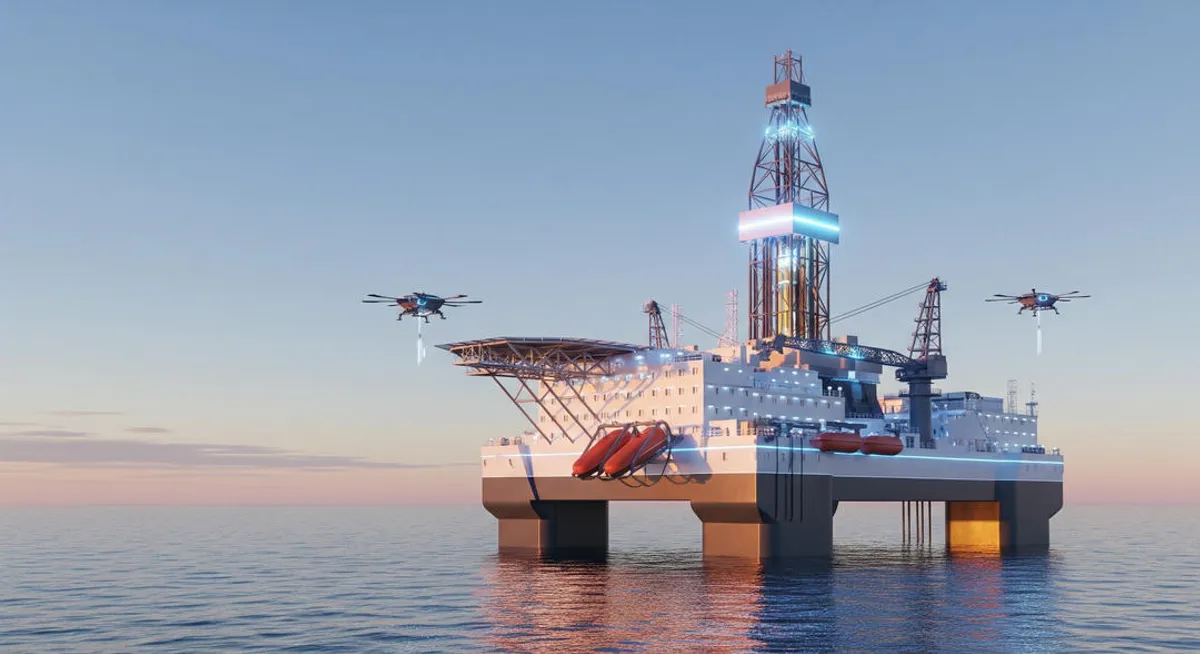
Future Trends, Automation, and Sustainability in Drilling
- Published August 3, 2025
The oil industry faces a future where operational efficiency and sustainability are key priorities, driven by the need to reduce costs, enhance safety, and minimize environmental impact. This chapter explores future trends in drilling, focusing on autonomous rigs and strategies for reducing carbon footprints. These innovations integrate technological advances, geological knowledge, well designs, equipment, and roles while addressing operational risks to build a more efficient and sustainable industry.
Automation in Drilling
Automation is transforming oil drilling, enabling faster, more precise, and safer operations. Autonomous rigs, equipped with artificial intelligence (AI), advanced sensors, and digital control systems, reduce human intervention, minimizing errors and optimizing processes. These technologies build on innovations like the top drive and MWD tools and are applied in both onshore and offshore rigs.
Autonomous Rigs
Autonomous rigs use automated systems to perform tasks such as drilling, pipe handling, and mud control, coordinated by software that integrates real-time data. For example, in the Permian Basin, automated rigs have reduced drilling time by 20% in horizontal wells.
Key components:
- Digital control systems: Computers adjust parameters like weight on bit (WOB) and revolutions per minute (RPM) based on MWD and LWD data.
- Robotics: Robotic arms handle pipes on the rig floor, reducing risks for roughnecks.
- Artificial intelligence: AI algorithms analyze geological data to optimize well trajectories and prevent issues like collapses.
- Advanced sensors: Monitor real-time pressure, temperature, and mud properties, alerting to anomalies such as kicks.
Advantages:
- Efficiency: Reduces non-productive time, as seen in directional well drilling in Vaca Muerta.
- Safety: Minimizes personnel exposure to hazardous tasks, aligning with HSE protocols.
- Precision: Improves trajectory accuracy, increasing contact with the reservoir rock.
Challenges:
- Initial cost: Implementing autonomous rigs requires significant investments, which must align with the AFE.
- Training: Operators, such as the Driller and Toolpusher, need training in digital systems.
- Technological dependency: Software or sensor failures can halt operations.
Practical Example
In the Johan Sverdrup field (North Sea), an automated drillship uses AI to adjust the well trajectory in real-time based on LWD data. This reduced drilling time by 15% and improved safety by minimizing human intervention on the rig floor.
Sustainability in Drilling
Sustainability is a growing priority in the oil industry, driven by environmental regulations and societal pressure to reduce carbon footprints. Sustainable strategies focus on minimizing emissions, optimizing resource use, and complying with HSE protocols, particularly in sensitive regions like the Gulf of Mexico or the Arctic.
Carbon Footprint Reduction
Drilling operations consume significant energy (diesel for rigs, generators on drillships) and produce CO₂, methane, and waste like mud cuttings. Strategies to reduce carbon footprints include:
- Rig electrification: Using renewable or hybrid electric power instead of diesel generators. For example, in the North Sea, some onshore rigs are connected to renewable energy grids, reducing emissions by 30%.
- Sustainable muds: Developing biodegradable or water-based drilling fluids that comply with environmental regulations. In Vaca Muerta, oil-based muds are being replaced with lower-impact synthetic alternatives.
- Waste management: Recycling drilling cuttings and treating wastewater to minimize aquifer impact.
- Process optimization: Automation reduces energy consumption by minimizing drilling time and operational errors.
- Carbon capture: Emerging technologies to capture and store CO₂ emitted during drilling, especially in offshore operations.
Advantages:
- Regulatory compliance: Aligns with environmental regulations, such as BSEE requirements for emission mitigation plans.
- Long-term cost reduction: Electrification and sustainable muds lower waste management expenses.
- Reputation: Improves the operator’s image among investors and local communities.
Challenges:
- Initial cost: Electrification and carbon capture technologies require significant investments.
- Limited infrastructure: In remote regions like the Arctic, connecting to renewable grids is challenging.
- Technological adaptation: Support teams need training to implement sustainable muds and automated systems.
Practical Example
In the Troll field (Norway), a semi-submersible rig uses partial electrification from renewable sources, reducing CO₂ emissions by 25%. Additionally, biodegradable muds have minimized environmental impact in the North Sea, complying with strict European regulations.
Integration of Automation and Sustainability
Automation and sustainability are interconnected: autonomous rigs optimize energy use, reducing emissions, while sustainable muds and electrification enhance operational efficiency. Interdisciplinary collaboration is key:
- Mud engineers develop biodegradable fluids compatible with automated systems.
- Wellsite geologists use real-time data to minimize unnecessary drilling, reducing energy consumption.
- The Company Man and Toolpusher integrate these technologies into the drilling plan, ensuring AFE compliance.
For example, in the Gulf of Mexico, an automated drillship with dynamic positioning (DP) systems uses synthetic muds and hybrid energy, achieving a 20% reduction in emissions and a 10% reduction in operational costs.
The following table summarizes the trends and their impacts:
| Trend | Description | Advantages | Challenges | Example |
|---|---|---|---|---|
| Autonomous Rigs | Use of AI, robotics, and sensors | Efficiency, safety, precision | Initial cost, training | Johan Sverdrup (North Sea) |
| Carbon Footprint Reduction | Electrification, sustainable muds, capture | Regulatory compliance, cost savings | Infrastructure, initial investment | Troll Field (Norway) |
Summary
Automation and sustainability trends are redefining oil drilling, with autonomous rigs improving efficiency and safety, and carbon footprint reduction strategies aligning the industry with environmental demands. These innovations integrate geological fundamentals, well types, equipment, roles, and lessons from operational failures, laying the foundation for a more efficient and responsible industry.
Practical Exercise
- Reflection question: How do you think rig automation can improve safety compared to traditional operations, and what challenges might it face in adoption?
- Research task: Investigate a recent sustainable drilling project (e.g., in the North Sea) and write a paragraph describing how electrification or sustainable muds were implemented.
- Technical question: Explain how digital control systems in an autonomous rig can optimize the drilling of a directional well.
Bibliography
-
Books used:
- Hyne, N.J. (2012). Nontechnical Guide to Petroleum Geology, Exploration, Drilling & Production. PennWell Books.
Explains technological and sustainable trends in an accessible manner. - Bourgoyne, A.T., Millheim, K.K., Chenevert, M.E., & Young, F.S. (1986). Applied Drilling Engineering. SPE Textbook Series.
Details advances in drilling automation.
- Hyne, N.J. (2012). Nontechnical Guide to Petroleum Geology, Exploration, Drilling & Production. PennWell Books.
-
Recommended books:
- Mitchell, R.F., & Miska, S.Z. (2011). Fundamentals of Drilling Engineering. SPE Textbook Series.
A technical resource on automation and sustainability. Available at: https://store.spe.org/Fundamentals-of-Drilling-Engineering-P113.aspx. - Azar, J.J., & Samuel, G.R. (2007). Drilling Engineering. PennWell Books.
Ideal for deepening knowledge on emerging technologies. Available at: https://www.pennwellbooks.com/drilling-engineering/.
- Mitchell, R.F., & Miska, S.Z. (2011). Fundamentals of Drilling Engineering. SPE Textbook Series.
-
Direct links:
- SPE (Society of Petroleum Engineers): Resources on automation and sustainability. https://www.spe.org/en/.
- IADC (International Association of Drilling Contractors): Information on autonomous rigs. https://www.iadc.org/.
- PetroSkills: Courses on emerging drilling technologies. https://www.petroskills.com/en/training/courses/advanced-drilling-technologies---adt.