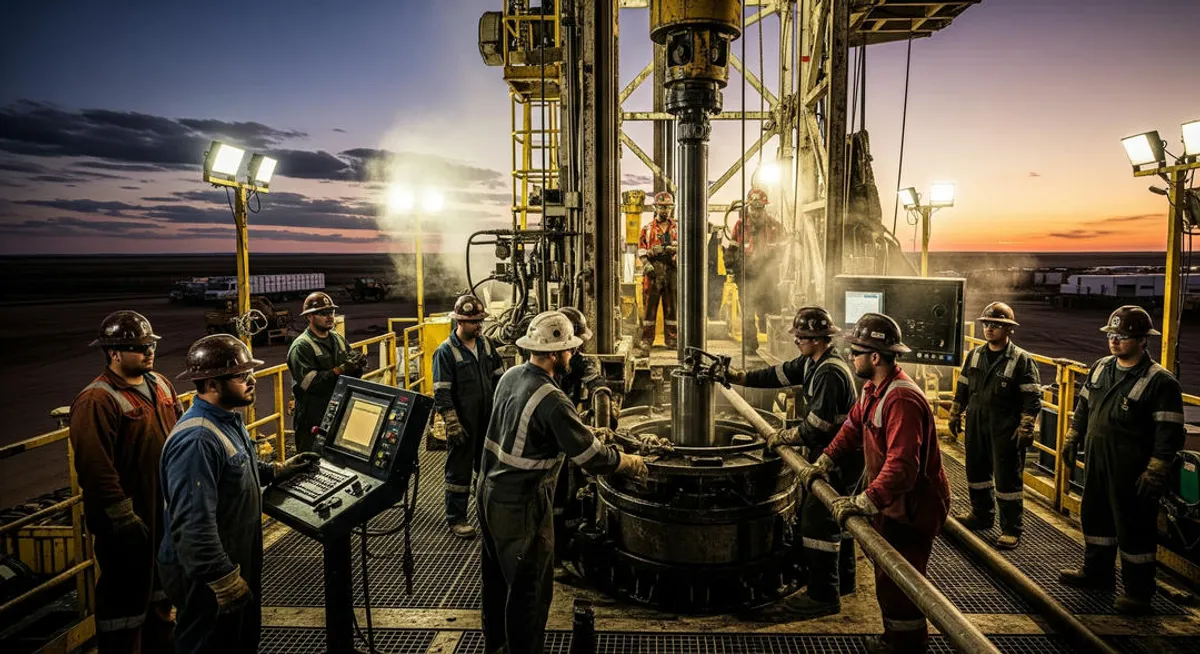
Organizational Structure in the Drilling Rig, Key Roles, and Hierarchy
- Published August 3, 2025
The operation of an oil drilling rig, whether onshore or offshore, is a symphony of coordination among highly trained teams and personnel. Each team member has a specific role within a well-defined hierarchy, ensuring that drilling is safe, efficient, and meets project objectives. This chapter details the organizational structure of the drilling rig, focusing on key roles: the Company Man, the Toolpusher, and the Driller. We will explore their responsibilities and how they interact to manage operations, connecting geological fundamentals, well types, equipment, and the well lifecycle with safety measures.
Organizational Structure in the Drilling Rig
The organizational structure of a drilling rig is designed to optimize communication, decision-making, and safety in a high-pressure environment. Roles are organized hierarchically, with the Company Man at the top representing the operator, followed by the Toolpusher, who oversees rig operations, and the Driller, who executes drilling tasks on the rig floor. Other roles, such as roughnecks, mud engineers, and support personnel, complement the structure. This hierarchy varies slightly between onshore and offshore operations, but the principles are universal.
General Hierarchy
- Company Man: The operator’s representative, responsible for overall supervision and strategic decision-making.
- Toolpusher: Rig supervisor, tasked with coordinating operations and managing personnel.
- Driller: Operates the rig controls on the floor, executing drilling tasks.
- Support Personnel: Includes roughnecks, mud technicians, wellsite geologists, and safety specialists, each with specific tasks.
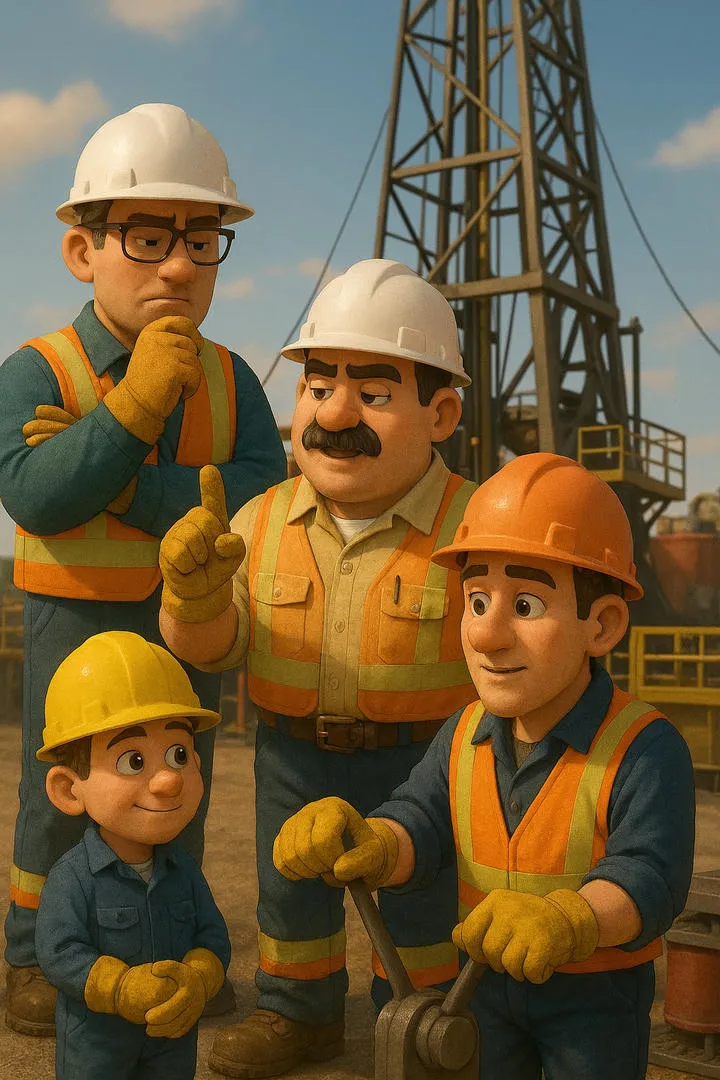
Communication flows bidirectionally: the Company Man sets objectives based on the well plan, the Toolpusher organizes the team to meet them, and the Driller executes operations, reporting real-time data. This structure ensures that technical decisions, such as adjusting the weight on bit (WOB) for hard formations, are implemented quickly.
Key Roles and Responsibilities
Company Man
The Company Man is the primary representative of the operating company at the drilling site, serving as the link between onshore management and rig operations. They are responsible for executing the drilling plan, meeting technical and economic objectives (such as the AFE), and adhering to safety and environmental regulations.
Responsibilities:
- Strategic oversight: Approves the daily drilling plan, ensuring alignment with geological objectives and well design.
- Cost management: Monitors the project budget, reviewing the AFE and authorizing additional expenses, such as MWD tool usage.
- Regulatory compliance: Ensures compliance with environmental permits and HSE regulations, reporting to authorities like the BSEE for offshore operations.
- Coordination with contractors: Works with the Toolpusher and other contractors to address technical issues, such as kicks or lost circulation.
- Critical decision-making: Makes decisions during emergencies, such as shutting in the well with blowout preventers (BOPs).
For example, in a directional well in the Gulf of Mexico, the Company Man coordinates with the wellsite geologist to adjust the well trajectory based on MWD data, ensuring the well reaches the reservoir rock.
Toolpusher
The Toolpusher is the overall rig supervisor, responsible for coordinating daily operations and managing on-site personnel. They act as an intermediary between the Company Man and the operational team, ensuring tasks are executed efficiently and safely.
Responsibilities:
- Personnel management: Oversees the Driller, roughnecks, and technicians, assigning shifts (typically 12 hours, especially offshore) and resolving conflicts.
- Equipment maintenance: Ensures the derrick, drawworks, and other components are operational, coordinating repairs if needed.
- Drilling plan implementation: Works with the Company Man to execute the plan, adjusting parameters like RPM or mud density based on well conditions.
- Safety: Conducts regular inspections and leads emergency drills, such as well control simulations.
- Operational reports: Prepares daily progress reports on drilling, which are sent to the Company Man and management.
In a conventional rig in Vaca Muerta, the Toolpusher might adjust oil-based mud to handle reactive shales, coordinating with the Driller to maintain well stability.
Driller
The Driller is the primary operator on the rig floor, managing the drilling equipment controls, such as the top drive or drawworks. They are responsible for executing drilling tasks, monitoring real-time parameters to ensure safety and efficiency.
Responsibilities:
- Rig operation: Adjusts the weight on bit (WOB) and revolutions per minute (RPM) based on formation properties.
- Real-time monitoring: Uses MWD and LWD tool data to track the well trajectory and detect anomalies, such as kicks.
- Mud management: Oversees the mud circulation system, adjusting its density or composition to control well pressure.
- Team coordination: Directs roughnecks in tasks like adding pipe or handling equipment on the rig floor.
- Emergency response: Activates the BOPs in case of a kick, following protocols set by the Toolpusher and Company Man.
In a jack-up rig in the North Sea, the Driller adjusts the well trajectory in real-time based on MWD data to keep the well within a productive sandstone layer.
The following table summarizes the key roles and their responsibilities:
| Role | Main Responsibilities | Primary Interaction | Example Task |
|---|---|---|---|
| Company Man | Strategic oversight, cost management, compliance | Management, Toolpusher | Approve drilling plan |
| Toolpusher | Operational coordination, personnel management, safety | Company Man, Driller | Oversee rig maintenance |
| Driller | Rig operation, monitoring, emergency response | Toolpusher, Roughnecks | Adjust WOB for hard formations |
Summary
The organizational structure of a drilling rig is a well-defined hierarchy that ensures the efficient and safe execution of drilling operations. The Company Man sets the strategy and ensures regulatory compliance, the Toolpusher coordinates the team and equipment, and the Driller executes drilling tasks on the rig floor. These roles connect geological fundamentals, well types, the well lifecycle, and equipment with safety and sustainability measures.
Practical Exercise
- Reflection question: Why do you think effective communication between the Company Man, Toolpusher, and Driller is crucial for safety on a drilling rig?
- Research task: Investigate an oilfield (e.g., Permian Basin) and write a paragraph describing how the roles of the Company Man and Toolpusher contribute to well operations.
- Technical question: Explain how the Driller uses MWD tool data to make decisions during drilling.
Bibliography
-
Books used:
- Hyne, N.J. (2012). Nontechnical Guide to Petroleum Geology, Exploration, Drilling & Production. PennWell Books.
Explains rig organization and roles in an accessible manner. - Bourgoyne, A.T., Millheim, K.K., Chenevert, M.E., & Young, F.S. (1986). Applied Drilling Engineering. SPE Textbook Series.
Details operational responsibilities and rig hierarchy.
- Hyne, N.J. (2012). Nontechnical Guide to Petroleum Geology, Exploration, Drilling & Production. PennWell Books.
-
Recommended books:
- Mitchell, R.F., & Miska, S.Z. (2011). Fundamentals of Drilling Engineering. SPE Textbook Series.
A technical resource on rig operations and organization. Available at: https://store.spe.org/Fundamentals-of-Drilling-Engineering-P113.aspx. - Azar, J.J., & Samuel, G.R. (2007). Drilling Engineering. PennWell Books.
Ideal for deepening knowledge on roles and operational coordination. Available at: https://www.pennwellbooks.com/drilling-engineering/.
- Mitchell, R.F., & Miska, S.Z. (2011). Fundamentals of Drilling Engineering. SPE Textbook Series.
-
Direct links:
- SPE (Society of Petroleum Engineers): Resources on drilling operations and roles. https://www.spe.org/en/.
- IADC (International Association of Drilling Contractors): Information on rig hierarchies. https://www.iadc.org/.
- PetroSkills: Courses on drilling operations management. https://www.petroskills.com/en/training/courses/drilling-practices---dp.