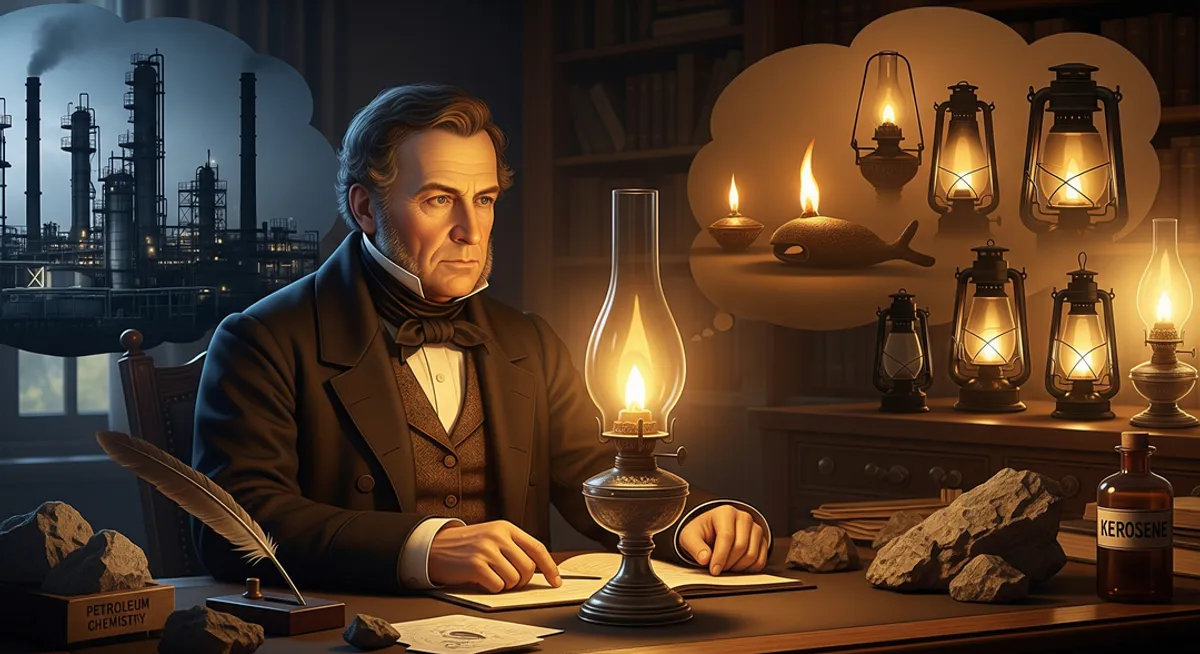
Abraham Gesner - Pioneer of the Modern Petroleum Industry
- Luis Condori
- August 2, 2025
- 4 mins
- Petroleum Industry
- biography kerosene petroleum industry
When Abraham Gesner developed kerosene in the 1840s, he didn’t just create a cleaner, cheaper fuel—he ignited the foundation of the modern petroleum industry. Abraham Gesner (1797–1864), a Canadian physician, geologist, and inventor, revolutionized lighting by replacing costly whale oil with kerosene, paving the way for an industry that would reshape the world. His story is one of scientific curiosity, resilience, and lasting impact.
Early Life and Challenges
Born on May 2, 1797, in Cornwallis Township, Nova Scotia, Abraham Pineo Gesner grew up in a family of German descent, the son of a Loyalist who emigrated to Canada after the American Revolution. Though trained as a physician, his true passion lay in geology, which he pursued through self-directed study from a young age.
- Gesner studied medicine in London, England, in 1825, at his father-in-law’s urging, but his interest in geology led him to conduct scientific expeditions in Nova Scotia and the Caribbean.
- He faced financial setbacks from failed business ventures, such as losing horses in shipwrecks while trading with the West Indies.
Gesner also encountered professional setbacks, including the loss of his geological collection due to debts and the termination of his role as provincial geologist in New Brunswick.
Contributions to the Petroleum Industry
Invention of Kerosene
In the 1840s, Gesner developed a process to distill kerosene from coal, bitumen, and oil shale, creating a fuel that was cleaner and more affordable than whale oil for lamps. In 1846, he publicly demonstrated his kerosene, which he initially called “keroselain” (from the Greek keros for wax and elaion for oil).
Key innovations:
- Kerosene distillation: His method produced a bright, clean-burning fuel that revolutionized domestic lighting.
- North American Kerosene Gas Light Company: In 1854, Gesner founded this company in New York, producing up to 5,000 gallons of kerosene daily by 1859.
Geological Contributions
As a geologist, Gesner conducted pioneering surveys in Nova Scotia and New Brunswick, publishing Remarks on the Geology and Mineralogy of Nova Scotia (1836) and five geological reports that highlighted the region’s mineral potential. His discovery of “albertite” in 1839, a bituminous material, was instrumental in his kerosene experiments.
Overcoming Barriers
Gesner faced numerous obstacles:
- Legal disputes: In 1859, Scottish chemist James Young won a patent lawsuit, forcing Gesner’s company to pay royalties, which limited his financial gains.
- Lack of recognition: Despite his invention, Gesner received little wealth or immediate acclaim and was replaced as chief chemist of his own company.
- Personal struggles: After losing his patents, he returned to Nova Scotia in 1863, where he died in 1864. His grave remained unmarked for 69 years until Imperial Oil erected a monument in 1933.
Legacy
Abraham Gesner transformed the lighting industry and laid the groundwork for modern petroleum refining. His kerosene not only replaced whale oil, aiding in the conservation of whale populations, but also spurred petroleum exploration following the discovery of oil fields in Pennsylvania in 1859. His book A Practical Treatise on Coal, Petroleum and Other Distilled Oils (1861) became a standard reference in the industry.
His Impact in Numbers
| Field | Contribution | Modern Importance |
|---|---|---|
| Petroleum Industry | Invention of kerosene (1846) | Launched modern petroleum refining |
| Geology | Surveys of Nova Scotia and New Brunswick | Foundation for mineral exploration in Canada |
| Lighting | Replacement of whale oil | Transformed global domestic lighting |
Why Gesner Matters Today
Gesner’s life exemplifies how scientific curiosity and perseverance can drive world-changing innovations. His invention of kerosene not only revolutionized lighting but also set the stage for the modern petroleum industry. His legacy endures in every kerosene lamp and the global energy infrastructure.
Further Reading
- A Practical Treatise on Coal, Petroleum and Other Distilled Oils by Abraham Gesner
- Remarks on the Geology and Mineralogy of Nova Scotia by Abraham Gesner
- “Dr Abraham Gesner: The Father of the Petroleum Industry” by T.J. Murray (Journal of the Royal Society of Medicine, 1993)
- American Oil & Gas Historical Society: Edwin Drake and the Birth of the U.S. Petroleum Industry